

10 Project Management Mistakes That Can Kill Your Software Project
Every software project starts with excitement.
The team is motivated.
The client has a clear vision.
The roadmap looks achievable.
Everyone believes the project will be delivered on time.
But as weeks pass, deadlines begin to slip.
Requirements keep changing.
Communication becomes confusing.
Developers become overwhelmed.
Stakeholders grow frustrated.
Eventually, the project that once looked promising begins to struggle.
Surprisingly, most software projects don't fail because of poor programming.
They fail because of poor project management.
According to the Project Management Institute (PMI), ineffective communication, unclear requirements, poor planning, and unmanaged risks remain among the leading causes of project failure.
The good news?
Most of these mistakes are preventable.
In this article, we'll explore ten common Project Management mistakes that can quietly destroy software projects—and, more importantly, how you can avoid them.
Why Project Management Matters More Than Ever

Modern software development is no longer just about writing code.
Projects involve developers, designers, QA engineers, DevOps engineers, Product Owners, Business Analysts, clients, and stakeholders.
Without effective coordination, even the most talented development team can struggle.
Project Management provides the structure that keeps everyone aligned toward the same objective.
Mistake #1 — Starting Development Without Clear Requirements
One of the biggest reasons projects fail is unclear requirements.
Many teams begin coding before fully understanding what needs to be built.
The result?
Constant revisions
Feature misunderstandings
Scope creep
Client dissatisfaction
Good Project Managers invest time in gathering, validating, and documenting requirements before development begins.
A well-written Software Requirements Specification (SRS) can save hundreds of development hours later.
Mistake #2 — Ignoring Stakeholder Communication

Communication problems rarely appear overnight.
They grow gradually.
Clients stop receiving updates.
Developers make assumptions.
Managers believe everything is on schedule.
Then suddenly, everyone realizes they have different expectations.
Regular communication through Sprint Reviews, status reports, stakeholder meetings, and project dashboards helps prevent misunderstandings before they become expensive problems.
Remember:
Silence is not progress.
Mistake #3 — Unrealistic Project Estimation
Many projects begin with deadlines that are based on optimism rather than data.
Developers estimate only coding time.
They forget:
Code reviews
Testing
Bug fixing
Documentation
Deployment
Meetings
As a result, projects consistently exceed their schedules.
Professional teams estimate the complete development lifecycle—not just programming.
Mistake #4 — Poor Risk Management
Every project contains uncertainty.
Ignoring risks does not make them disappear.
Common software risks include:
Requirement changes
Third-party API failures
Team turnover
Security vulnerabilities
Infrastructure downtime
Successful Project Managers identify risks early, assess their impact, and prepare mitigation strategies before problems occur.
Risk Management is proactive, not reactive.
Mistake #5 — Micromanaging Developers
One common misconception is that managing people means controlling every task.
In reality, micromanagement often reduces productivity.
Developers perform best when they:
Understand project goals.
Have ownership of their work.
Receive constructive feedback.
Feel trusted by leadership.
Project Managers should remove obstacles—not become obstacles.
Mistake #6 — Ignoring Technical Debt
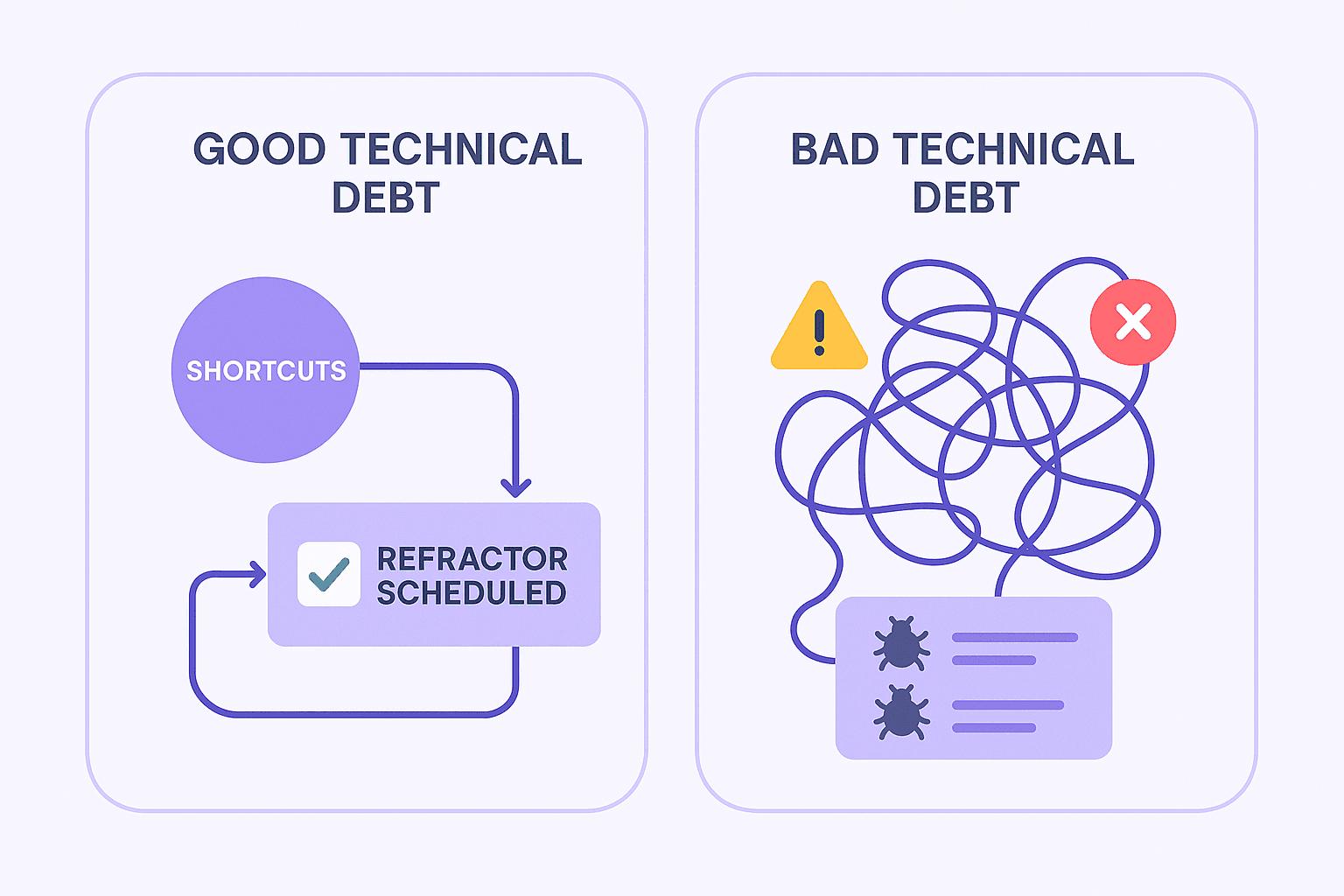
Technical debt accumulates when teams prioritize speed over quality.
Examples include:
Poor architecture
Duplicate code
Missing documentation
Temporary fixes
Skipping testing
Initially, these shortcuts seem harmless.
Over time, they dramatically slow future development.
Successful teams allocate time to continuously reduce technical debt.
Mistake #7 — Treating Agile Like a Checklist
Many organizations claim to be Agile.
Yet they simply rename meetings without changing their mindset.
True Agile focuses on:
Customer collaboration
Continuous improvement
Frequent feedback
Adaptability
Incremental delivery
Agile is not about holding Daily Standups.
It is about delivering value continuously.
Mistake #8 — Skipping Quality Assurance
Some teams postpone testing until development is complete.
This creates a dangerous situation.
Large numbers of defects appear simultaneously.
Developers rush to fix bugs.
Deadlines move.
Customer confidence decreases.
Testing should occur throughout the development lifecycle—not only at the end.
Quality is everyone's responsibility.
Mistake #9 — Failing to Document Decisions
Projects often rely too heavily on verbal communication.
Months later, nobody remembers:
Why a feature was changed.
Who approved a requirement.
Which architecture decision was chosen.
Good documentation reduces confusion and speeds future maintenance.
Useful documentation includes:
Meeting notes
Architecture decisions
API documentation
Requirement updates
Change requests
Documentation saves time—not wastes it.
Mistake #10 — Measuring Success Only by Deadlines
Finishing on time does not automatically mean success.
Imagine delivering software exactly as planned...
But users don't like it.
The application is difficult to use.
Business goals are not achieved.
Was the project successful?
Probably not.
True project success balances:
Business value
Customer satisfaction
Software quality
Team health
Delivery performance
Project Management is about creating value—not simply finishing tasks.
How Successful Teams Avoid These Mistakes
The highest-performing software teams typically:
Define requirements clearly.
Communicate consistently.
Review risks regularly.
Estimate realistically.
Encourage collaboration.
Automate testing.
Continuously improve processes.
Document important decisions.
Learn from every Sprint.
Focus on delivering customer value.
Project Management is not about preventing every problem.
It is about responding effectively when problems inevitably occur.
Real-World Example
Imagine a startup developing a mobile banking application.
Initially, everything appears under control.
However, after three months:
The client requests additional features.
The security team identifies critical vulnerabilities.
One senior developer resigns.
The payment provider updates its API.
Testing is delayed until the final week.
None of these problems are unusual.
The real issue is that the team never planned for them.
With proper requirement management, stakeholder communication, risk management, documentation, and realistic planning, most of these challenges could have been significantly reduced.
Conclusion
Successful software projects are rarely the result of luck.
They succeed because teams follow disciplined Project Management practices.
Avoiding these ten mistakes won't guarantee perfection.
However, it will dramatically improve your team's ability to deliver software that is on time, within budget, and aligned with business goals.
Remember:
Projects rarely fail because of one catastrophic mistake.
They fail because small mistakes accumulate over time.
Fix the small problems early, and you'll prevent much bigger ones later.
Frequently Asked Questions (FAQ)
What is the most common Project Management mistake?
Unclear requirements remain one of the leading causes of software project failure because they affect planning, estimation, development, testing, and stakeholder expectations.
Can good Project Management save a struggling software project?
Yes. While not every project can be fully recovered, improving communication, redefining priorities, managing risks, and aligning stakeholders can significantly increase the chances of success.
Is Project Management only for Project Managers?
No. Developers, Tech Leads, Product Owners, Scrum Masters, Business Analysts, and Engineering Managers all benefit from understanding Project Management principles.