
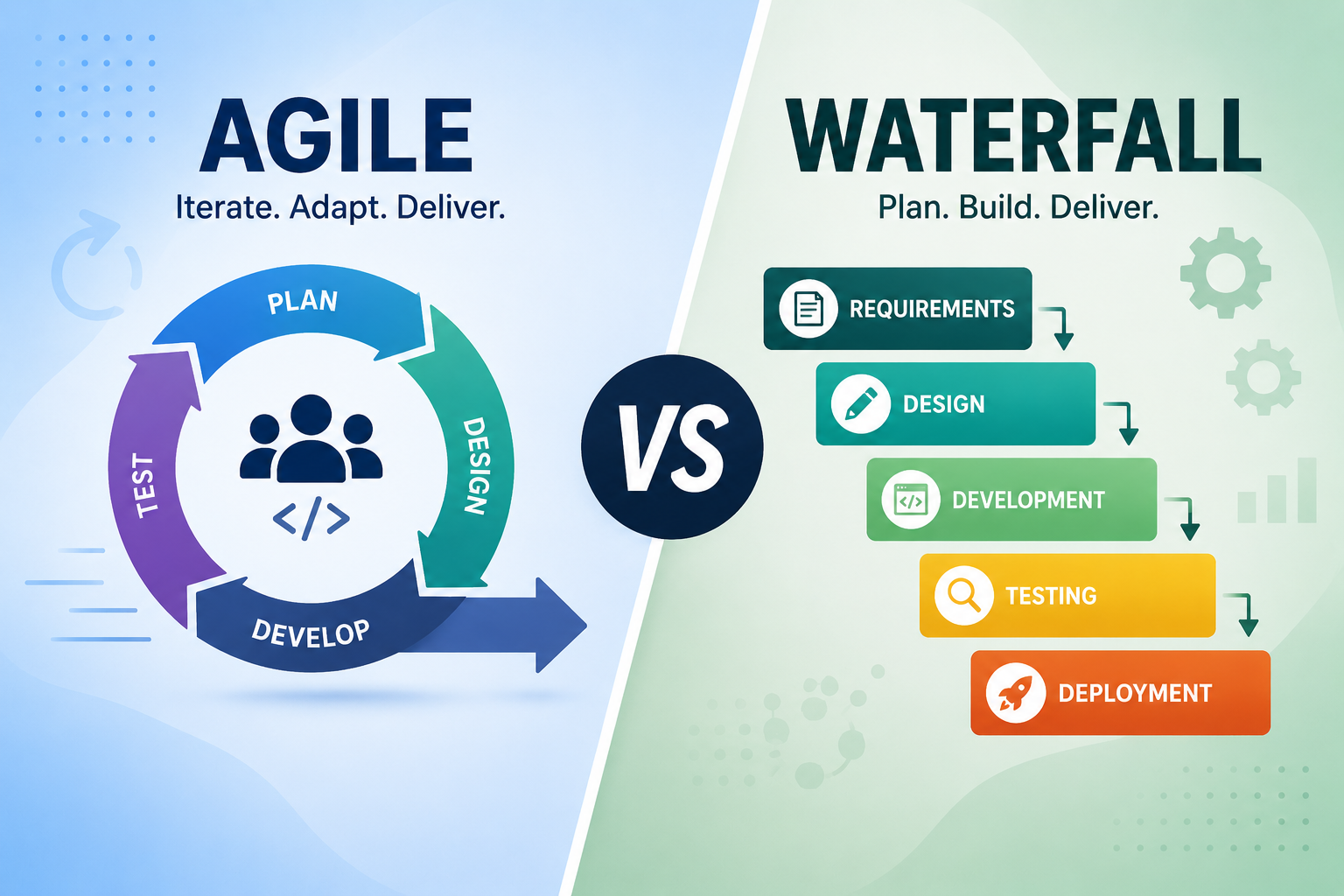
Agile vs Waterfall: Which One Should You Choose for Your Project?
Choosing the right software development methodology is one of the most important decisions at the beginning of a project.
Many teams immediately choose Agile because it's popular.
Others still rely on Waterfall because it's structured and predictable.
The truth is, neither methodology is universally better.
The best choice depends on your project's goals, team structure, client expectations, and the level of change expected during development.
Understanding the strengths and limitations of both approaches will help you make smarter project decisions.
What Is Waterfall?
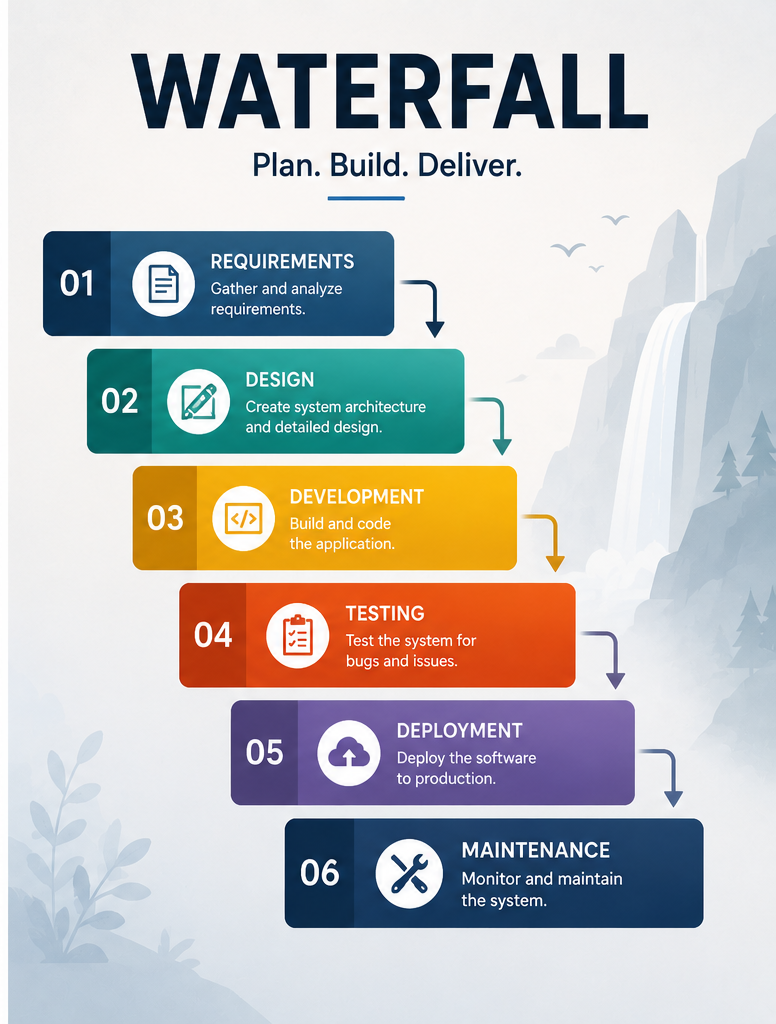
Waterfall is a traditional project management methodology where work is completed in a sequential order.
Each phase must be completed before moving to the next.
A typical Waterfall process looks like this:
Requirements Gathering
System Design
Development
Testing
Deployment
Maintenance
Once a phase is completed, returning to a previous phase is usually expensive and time-consuming.
This methodology emphasizes detailed planning before development begins.
Advantages of Waterfall
Waterfall works well because:
Project scope is clearly defined.
Documentation is comprehensive.
Budget estimation is easier.
Timeline is more predictable.
Progress is easier to track.
For projects with stable requirements, Waterfall can be highly efficient.\
Limitations of Waterfall
Despite its advantages, Waterfall has limitations.
If client requirements change during development:
Documentation must be updated.
Design may need revision.
Development may need rework.
Testing must be repeated.
As a result, changes become expensive later in the project.
What Is Agile?
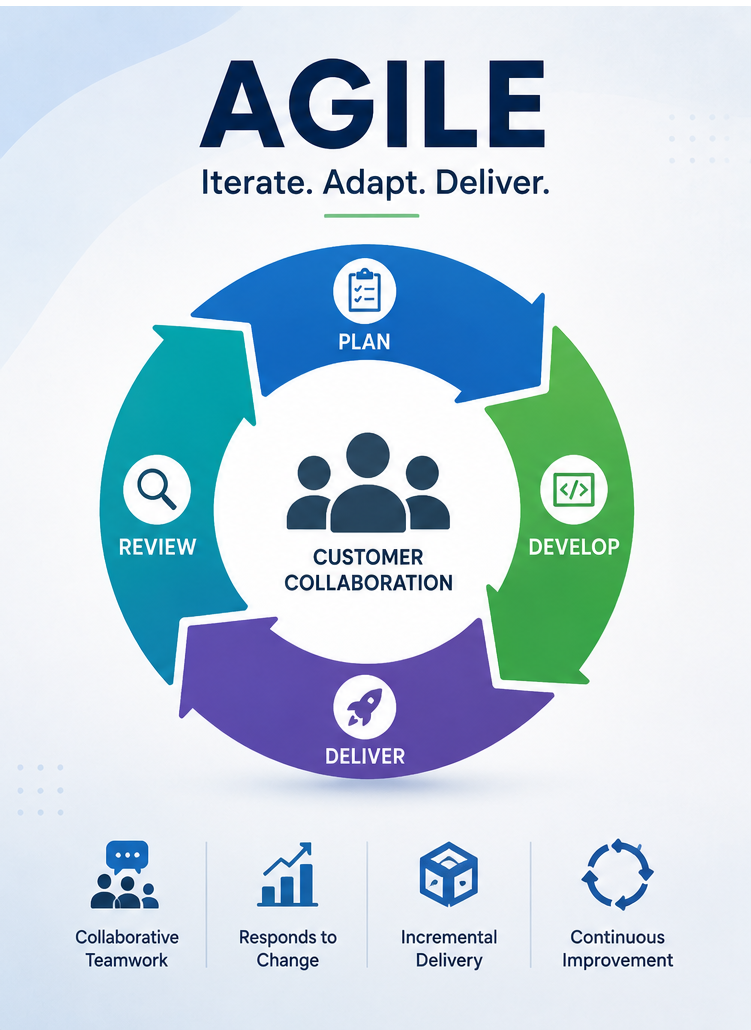
Agile is an iterative and flexible software development methodology.
Instead of delivering the entire system at the end of the project, Agile delivers software incrementally through short development cycles called Sprints.
Each Sprint typically lasts between one and four weeks.
After every Sprint, the team reviews progress, gathers feedback, and adjusts priorities if necessary.
This allows software to evolve continuously based on real user needs.
Advantages of Agile
Agile provides several important benefits:
Faster delivery of working software.
Better adaptation to changing requirements.
Continuous customer feedback.
Lower project risk.
Greater collaboration between business and development teams.
Continuous improvement after every Sprint.
For modern digital products, Agile has become the preferred methodology.
Limitations of Agile
Agile also comes with challenges.
Without proper planning:
Scope can grow unexpectedly.
Stakeholder expectations may constantly change.
Budget prediction becomes more difficult.
Documentation may receive less attention.
Teams require active communication.
Agile demands discipline—not just flexibility.
Aspect | Agile | Waterfall |
|---|---|---|
Development Approach | Iterative | Sequential |
Planning | Flexible | Detailed upfront |
Requirement Changes | Easy to accommodate | Difficult and costly |
Customer Involvement | Continuous | Mostly at the beginning and end |
Delivery | Incremental | Final delivery |
Documentation | Lightweight | Extensive |
Risk | Lower through continuous feedback | Higher if requirements change |
Best For | Dynamic projects | Stable projects |
When Should You Choose Waterfall?
Waterfall is a better choice when:
Requirements are fixed.
Government or regulated projects require extensive documentation.
Budget and timeline must be predictable.
Scope changes are unlikely.
The client prefers detailed planning before development starts.
Examples include:
Banking systems
Government applications
Infrastructure projects
Healthcare systems with strict regulations
When Should You Choose Agile?
Agile is ideal when:
Requirements are expected to evolve.
Customer feedback is essential.
Products need rapid releases.
Innovation is important.
Teams work collaboratively.
Examples include:
Startup products
SaaS platforms
Mobile applications
E-commerce platforms
AI-based products
Can Agile and Waterfall Be Combined?
Absolutely.
Many organizations adopt a Hybrid Project Management approach.
For example:
Use Waterfall during project initiation and requirement analysis.
Use Agile during software development.
Return to structured documentation for deployment and compliance.
Hybrid approaches allow teams to benefit from both methodologies.
Common Mistakes When Choosing a Methodology
Avoid these mistakes:
Choosing Agile simply because it's trendy.
Assuming Waterfall is outdated.
Ignoring team experience.
Forgetting stakeholder involvement.
Selecting a methodology without considering project complexity.
The methodology should serve the project—not the other way around.
Which Methodology Do I Recommend?
After working on software projects with different levels of complexity, I've learned that there is no single "best" methodology.
For software products that evolve quickly and require continuous feedback, Agile is often the better choice.
For projects with fixed requirements, strict regulations, or limited changes, Waterfall remains an excellent option.
The smartest teams focus less on methodology labels and more on delivering value.
Conclusion
Agile and Waterfall are not competitors.
They are different approaches designed for different situations.
Understanding your project goals, stakeholders, budget, timeline, and expected changes will help you choose the right methodology.
At the end of the day, successful software is not defined by whether you use Agile or Waterfall.
It's defined by whether the project solves real problems and delivers value to its users.
Frequently Asked Questions
Is Agile better than Waterfall?
Not always. Agile is better for projects with changing requirements, while Waterfall works well for projects with stable and well-defined requirements.
Can small teams use Agile?
Yes. Agile is suitable for teams of all sizes as long as they communicate effectively and follow Agile principles.
Do large companies still use Waterfall?
Yes. Many industries such as banking, healthcare, government, and construction still rely on Waterfall because of regulatory and documentation requirements.