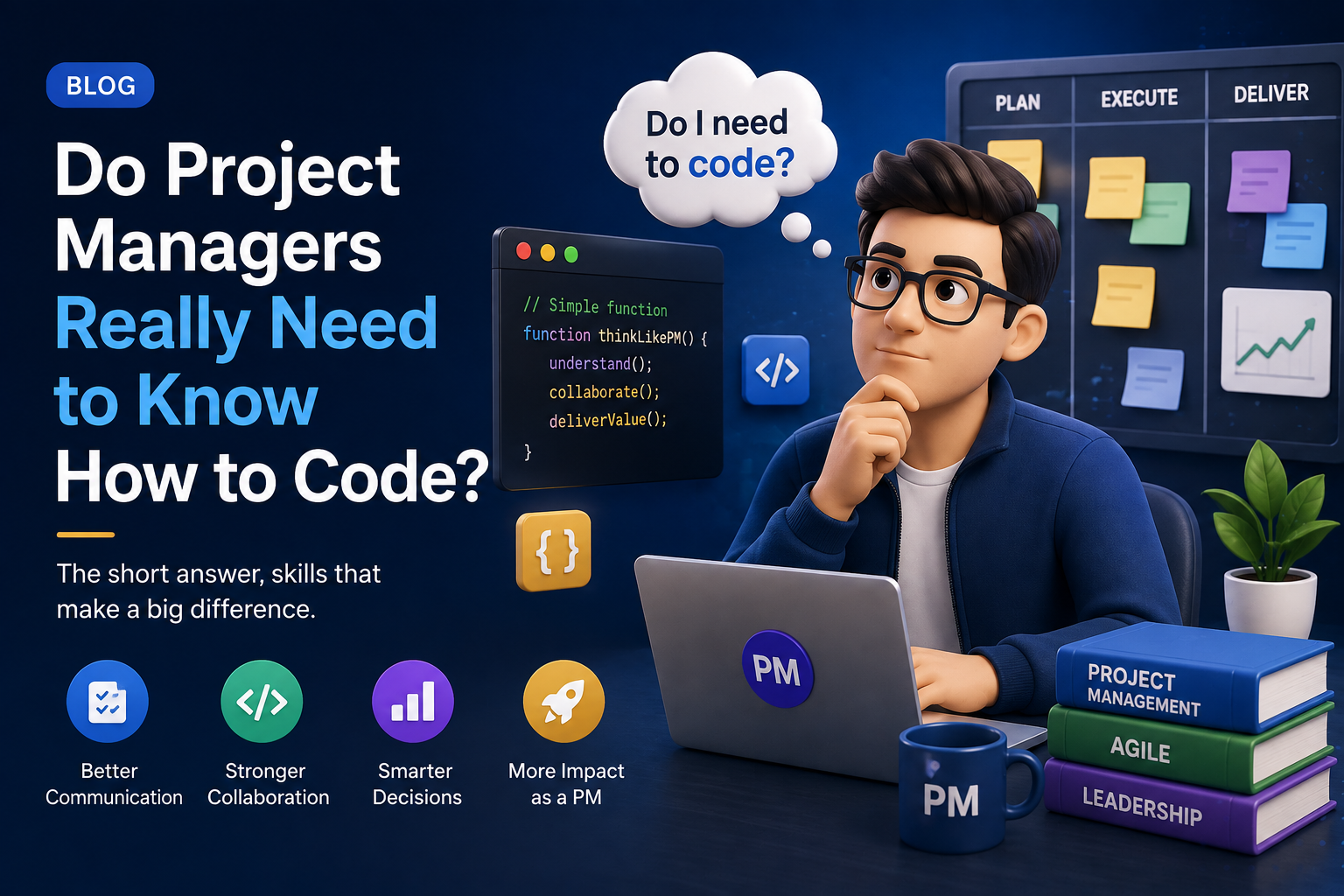
Do project managers really need to know how to code?
This question comes up quite often in software teams.
Some people believe a good project manager should understand programming.
Others think:
“That's what developers are for.”
And honestly, I think both sides have a point.
A project manager doesn't necessarily need to become a professional developer.
But when you're managing a software project, having a basic understanding of technology can make your job significantly easier.
You don't need to write production-ready code.
You don't need to memorize every programming language.
You don't need to understand every framework your team uses.
But understanding how software is built can help you communicate better, estimate more realistically, identify risks earlier, and make better project decisions.
So, let's answer the question properly.
The Short Answer: No, But It Helps a Lot
No, a project manager doesn't need to know how to code.
At least not in the sense of being able to build an entire application from scratch.
A good project manager can absolutely manage developers without becoming a developer themselves.
However, there's a big difference between:
Knowing how to code
and
Understanding software development.
The second one is much more important.
A project manager should understand concepts like:
Frontend vs backend
APIs
Databases
Testing
Deployment
Dependencies
Technical debt
Development environments
Bugs and incidents
Software estimation
You don't need to implement these things yourself.
But you should understand enough to ask good questions.
Why Technical Knowledge Helps Project Managers
Imagine a developer tells you:
“We can't release this feature today because the API changes haven't been completed and the frontend depends on them.”
A project manager without technical context might hear:
“The developers need more time.”
A project manager with basic technical understanding might immediately ask:
“Is the API change blocking the frontend integration?”
That is a much better question.
The goal isn't to solve the technical problem yourself.
The goal is to understand what's happening well enough to manage the project around it.
You Don't Need to Become a Developer
This is probably the biggest misconception.
When I say project managers should understand technology, I don't mean they need to spend six months learning React, Node.js, Python, Kubernetes, AWS, and PostgreSQL.
That's unnecessary for most project management roles.
Think about it as levels.
Level 1: Basic Technical Literacy
You understand concepts such as:
What an API is
What a database does
What frontend and backend mean
What deployment means
What a bug is
What testing involves
This is already extremely useful.
Level 2: Development Awareness
You understand:
Git
Branches
Pull requests
Environments
CI/CD
Authentication
Integrations
Dependencies
Technical debt
Now you can participate more confidently in technical conversations.
Level 3: Hands-On Coding
You can write code yourself.
This can be valuable, but it's not mandatory for every project manager.
Level 4: Technical Expertise
You can design architecture, review code, debug systems, and make technical decisions.
At this point, you're moving toward roles such as:
Technical Project Manager
Engineering Manager
Technical Program Manager
Solutions Architect
Not every project manager needs to reach this level.
Technical Knowledge Makes Estimation Better
One of the areas where technical understanding is especially valuable is project estimation.
Imagine a stakeholder says:
“We just need to add Google login. It should take a day, right?”
Without technical context, a project manager might accept that estimate.
But someone familiar with software development knows the feature may involve:
OAuth configuration
Backend changes
Frontend integration
User account linking
Security considerations
Testing
Deployment
Production configuration
Suddenly, that “one-day feature” looks very different.
You don't need to estimate the work yourself.
But you should understand why the estimate might be larger than it sounds.
That's a valuable project management skill.
Developers Don't Always Speak Business Language
Here's another reason technical understanding helps.
Developers often communicate in technical terms.
Stakeholders usually communicate in business terms.
A developer might say:
“The service has a downstream dependency and we're waiting for an API contract.”
The business stakeholder might hear:
“Something technical is broken.”
A project manager can bridge the two worlds.
For example:
“The feature depends on another team delivering an API definition first. Until that is available, our developers can't complete the integration.”
Now the business side understands the actual blocker.
That's one of the most valuable roles a technical project manager can play:
Translation.
You Can Spot Technical Risks Earlier
Technical knowledge can help project managers recognize risks before they become major problems.
For example:
“We're integrating with a third-party payment provider.”
A technically aware project manager might immediately ask:
Is the API documented?
Do we have a sandbox environment?
Are there rate limits?
Are there webhook dependencies?
How will failures be handled?
Do we have test credentials?
What happens if the provider is unavailable?
Those questions may prevent surprises later.
Without technical context, some of those risks might not be identified until the team is already deep into implementation.
Understanding Technical Debt Matters
Technical debt is another concept project managers should understand.
A developer might say:
“We can deliver this quickly, but we'll create technical debt.”
What does that mean?
It doesn't necessarily mean the code is bad.
It usually means the team is choosing a faster or simpler implementation now that may create additional cost or maintenance work later.
For example:
Fast Solution
     ↓
Ship Now
     ↓
Technical Debt
     ↓
More Work Later
A project manager doesn't need to decide exactly how the code should be refactored.
But they should understand the trade-off.
The question becomes:
“Are we intentionally accepting this debt, and when will we address it?”
That's much more useful than simply saying:
“Just make it work.”
Technical Knowledge Improves Communication With Developers
Developers can usually tell when someone understands the basics of software development.
You don't need to impress them with technical vocabulary.
Actually, trying too hard can have the opposite effect.
You don't need to say:
“Let's use event-driven microservices with CQRS and Kafka.”
unless there's a real reason to discuss those technologies.
Instead, ask practical questions:
“What is blocking the work?”
“What dependency are we waiting for?”
“What could make this estimate change?”
“Is this a technical risk or a requirement problem?”
Those questions show that you're interested in the actual problem.
Developers usually appreciate that.
It Also Helps With Stakeholder Management
Technical understanding isn't only useful when talking to developers.
It's equally useful when talking to business stakeholders.
Suppose someone says:
“Can't we just add this feature before Friday?”
You can explain:
“Technically it's possible, but it affects the current database structure and needs regression testing. If we prioritize it now, the reporting feature will move to the next sprint.”
You're not being a developer.
You're using technical understanding to make a better project decision.
That's the difference.
Project Managers Need to Understand Dependencies
Software projects are full of dependencies.
For example:
Frontend
    ↓
API
    ↓
Backend
    ↓
Database
    ↓
Third-Party Service
A project manager needs to understand that these components aren't always independent.
If the API contract changes, frontend development may be affected.
If a database migration is delayed, the backend feature might be blocked.
If a third-party service isn't ready, integration testing may not start.
Understanding these relationships helps project managers build more realistic plans.
What Happens If a Project Manager Has Zero Technical Knowledge?
It's still possible to manage the project.
But some challenges become harder.
For example:
Unrealistic Deadlines
You may accept estimates without understanding the assumptions behind them.
Miscommunication
Technical and business teams may misunderstand each other more often.
Hidden Dependencies
Important technical blockers may not become visible until late.
Poor Prioritization
Technical risks may look less important than feature requests.
Difficult Escalations
When something goes wrong, explaining the situation to leadership becomes harder.
This doesn't mean every project manager without coding experience will struggle.
Strong communication and project management skills still matter enormously.
But technical literacy can make those skills much more effective in software environments.
What Should a Project Manager Actually Learn?
Instead of trying to learn everything, focus on the concepts that help you manage projects.
Software Architecture
Understand the basic idea of:
Frontend
Backend
APIs
Databases
Services
Infrastructure
You don't need to design the architecture.
Just understand how the pieces interact.
Version Control
Learn the basics of:
Git
Branches
Commits
Pull requests
Merging
You should understand how changes move from development into a release.
Environments
Know the difference between:
Development
Staging
Production
This alone can prevent a lot of confusion.
Testing
Understand:
Unit testing
Integration testing
Regression testing
User acceptance testing
Deployment
Understand the basic release process:
Code
 ↓
Build
 ↓
Test
 ↓
Deploy
 ↓
Monitor
APIs and Integrations
Know what an API does.
Understand requests, responses, authentication, and third-party integrations at a high level.
Databases
You don't need to become a database administrator.
But understand tables, relationships, queries, indexes, and migrations.
Security
Know basic concepts such as:
Authentication
Authorization
Secrets
Permissions
HTTPS
This is especially important when managing projects that handle user or business data.
Should Project Managers Learn to Code?
Here's where I would say:
Learning some coding is a great idea.
Not because you need to become a developer.
But because writing even a little code can change how you understand development.
You start to appreciate:
“Oh, this feature isn't just a button on the screen.”
You understand that behind that button may be:
Frontend → API → Backend → Database
You also experience something developers deal with every day:
“Why does this work locally but not in production?”
That experience can be surprisingly valuable.
Even basic coding exercises can improve your technical intuition.
What If You Don't Like Coding?
That's completely fine.
Being a good project manager doesn't require loving programming.
You can still build strong technical literacy through:
Reading technical documentation
Sitting in architecture discussions
Joining refinement sessions
Asking developers questions
Learning basic system concepts
Reviewing project diagrams
Understanding incident reports
You can become technically aware without becoming a programmer.
The Best Project Managers Know When to Ask
This may be the most important skill.
You don't have to know every technical answer.
You need to know which questions to ask.
For example:
“What's the biggest technical risk?”
“What assumption is this estimate based on?”
“What dependency can block this release?”
“What happens if this service goes down?”
“Do we have a fallback?”
“Can we reduce the scope without creating unnecessary technical debt?”
Those questions can be more valuable than knowing how to write the code yourself.
Technical Knowledge Should Support, Not Replace, Project Management
There's another trap to avoid.
A project manager who learns to code might become too involved in technical decisions.
Suddenly they're telling developers:
“You should implement it this way.”
That's usually not the goal.
Developers are hired for their technical expertise.
A project manager's responsibility is different.
You manage:
Scope
Timeline
Risk
Dependencies
Communication
Stakeholder expectations
Technical knowledge should help you manage those areas better.
It shouldn't turn you into an unofficial developer.
The Sweet Spot: Technical Enough, Not Technical Everything
I think there is a useful middle ground.
A strong software project manager should be:
Technical enough to understand the conversation.
Business-minded enough to understand the impact.
Communication-focused enough to connect both sides.
That's the sweet spot.
You don't need to know every programming language.
You don't need to understand every line of code.
You need enough technical context to make informed decisions.
Final Thoughts
So, do project managers really need to know how to code?
No.
But should project managers working on software projects understand technology?
Absolutely.
There's a huge difference between being able to code and being technically literate.
You don't need to become a developer.
You need to understand enough about software development to:
Ask better questions
Build realistic plans
Understand estimates
Identify dependencies
Recognize technical risks
Communicate with developers
Explain technical issues to stakeholders
Make better trade-offs
At the end of the day, the best project manager isn't the person who can write the most code.
It's the person who can bring business goals, technical reality, and people together.
And sometimes, knowing a little bit about what's happening behind the code can make that job a whole lot easier.
Need Help Bridging Business and Technology?
Good software projects need more than code. They need clear requirements, realistic planning, technical understanding, and communication between business and engineering teams.
I work across software development, backend systems, API integration, software architecture, and technical project planning, and I'm open to freelance projects, consulting, and technical collaborations.
If you're building a digital product, improving an existing system, or need help turning business requirements into a practical technical plan, let's discuss it.
Have a project in mind? Let's turn the idea into a plan your technical team can actually build.
Do you think a project manager should learn to code, or is technical literacy enough?