
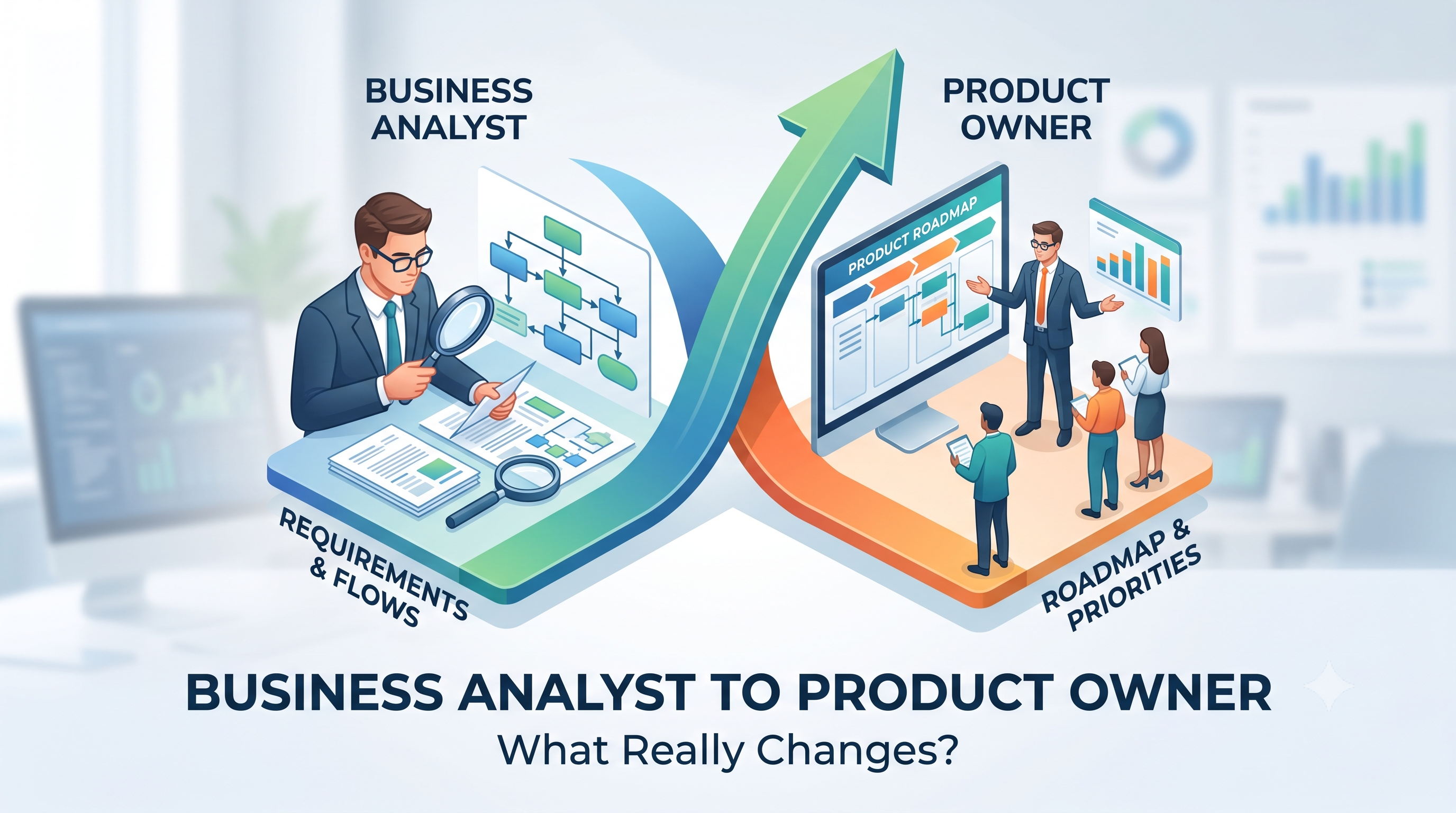
Business Analyst to Product Owner: What Really Changes?
Moving from a Business Analyst (BA) to a Product Owner (PO) may look like a simple change of title.
In reality, it is much more than that.
The biggest change is not necessarily what you do, but how you think and make decisions.
A Business Analyst typically focuses on understanding problems, gathering stakeholder requirements, documenting needs, and ensuring that the delivered solution aligns with business requirements.
A Product Owner, however, takes a broader perspective.
The focus shifts toward product value, prioritization, customer needs, and business outcomes.
A simple way to describe the shift is:
Business Analyst → Understand the problem
Product Owner → Own the solution and outcome
That's why the journey from Business Analyst to Product Owner is better understood as a mindset shift rather than simply a title change.
Business Analyst vs Product Owner
Area | Business Analyst | Product Owner |
|---|---|---|
Focus | Understanding the problem | Understanding the opportunity |
Orientation | Requirements | Product value |
Success | Clear requirements and stakeholder alignment | Customer value and business impact |
Main Activities | Gathering & documenting requirements | Prioritization & product decisions |
Key Question | "What is needed?" | "What creates the most value?" |
Decision Making | Based on requirements | Based on value, data, and priorities |
Perspective | Problems & requirements | Product & outcomes |
These roles are not completely separate.
In some organizations, their responsibilities overlap significantly.
However, their primary mindset and orientation can be different.
1. From Understanding the Problem to Understanding the Opportunity
One of the biggest mindset shifts is how you look at a problem.
Business Analyst
A Business Analyst often starts by asking:
"What problem is the business or customer experiencing?"
The BA then investigates:
Business requirements
User requirements
Pain points
Business processes
Stakeholder expectations
Business rules
The goal is to develop a clear understanding of the problem.
Product Owner
A Product Owner needs to go one step further:
"Is this problem actually an opportunity worth solving?"
The PO needs to consider:
How significant is the problem?
Who is affected?
How frequently does it occur?
What business value could be created?
How does it compare with other opportunities?
This is one of the most important mindset shifts when moving from BA to PO.
2. From Requirements to Outcomes
Business Analysts often spend significant time ensuring that requirements are properly understood and documented.
For example:
Users need to log in using Google.A Business Analyst might translate this into:
Business requirements
Functional requirements
User stories
Acceptance criteria
Business rules
A Product Owner needs to go further.
The question is not only:
"Did we deliver Google Login?"
The more important question is:
"Did this feature achieve the outcome we wanted?"
Perhaps the actual objective was:
Reduce friction during registration and login.
The outcome could then be measured through:
Registration conversion rate
Login success rate
Drop-off rate
Active users
The mindset shifts from:
Output → Outcome
3. From Gathering Requirements to Identifying Opportunities
Requirement gathering is an important part of Business Analysis.
A BA may conduct:
Stakeholder interviews
Workshops
Observation
Requirement analysis
Documentation
Process mapping
A Product Owner, however, needs to look for opportunities.
Suppose a stakeholder says:
"We need a new dashboard."
The PO should not immediately respond:
"Sure, I'll add it to the backlog."
Instead, ask:
"What problem are we trying to solve?"
Then:
"Who needs this information?"
And:
"What business impact will it create?"
This helps ensure that the team is not simply building features, but building something valuable.
4. From Delivering What Was Asked to Saying No
This is one of the most important skills for a Product Owner.
A Business Analyst often helps ensure that stakeholder needs are correctly understood and translated.
A Product Owner must sometimes say:
"No."
Not because the PO doesn't care about stakeholders.
Quite the opposite.
The PO must protect the product team's focus and ensure that effort is spent on the highest-value opportunities.
If 20 stakeholders submit requests, not every request should immediately become a priority.
A Product Owner needs to determine:
High Value + High Impact
↓
Prioritize
Low Value + Low Impact
↓
Delay
Being able to say "not now" is an important part of product ownership.
5. From Requirement Delivery to Value Delivery
Imagine a team successfully delivers 20 features in one quarter.
Does that automatically mean the product is successful?
Not necessarily.
Because:
A delivered feature does not automatically equal delivered value.
For example:
20 Features Delivered
↓
But...
↓
User Adoption ↓
Revenue ↓
Retention ↓
A Product Owner should ask:
Are customers actually using the feature?
Did we solve the customer's problem?
Did conversion improve?
Did revenue increase?
Did retention improve?
Did operational costs decrease?
This is the difference between output and outcome.
6. Prioritization Becomes a Critical Skill
As a Business Analyst, you may already be comfortable with analysis.
As a Product Owner, you need to turn that analysis into decisions.
For example:
Feature | Impact | Effort | Priority |
|---|---|---|---|
Feature A | High | Low | High |
Feature B | High | High | Medium |
Feature C | Low | Low | Low |
Feature D | Low | High | Very Low |
The Product Owner must answer:
What should we build first?
Common prioritization frameworks include:
RICE
MoSCoW
Value vs Effort
WSJF
Impact vs Effort
But frameworks are only tools.
The real skill is being able to make good product decisions based on value.
7. Product Owners Must Be Comfortable With Trade-Offs
Product development rarely gives you:
High value + low effort + zero risk.
You usually have to make trade-offs.
For example:
Option A
High Impact
High Cost
Option B
Medium Impact
Low Cost
Which one should you choose?
There isn't always a universal answer.
A Product Owner needs to consider:
Business value
Customer impact
Technical complexity
Risk
Cost
Time
Strategic direction
This is the reality of product decision-making.
8. Making Decisions with Incomplete Information
Another important mindset shift is becoming comfortable with imperfect information.
A Business Analyst may spend significant time gathering and validating information before a requirement is finalized.
A Product Owner sometimes has to make decisions before all the data is available.
For example:
"We have 70% of the information, but we need to make a decision this week."
The PO may need to say:
"Based on the information available, this is the best decision we can make right now."
The decision can then be validated through experiments, customer feedback, or new data.
Business Analyst Skills That Are Valuable for Product Owners
If you're a Business Analyst looking to become a Product Owner, you already have a strong foundation.
Requirements Analysis
You already understand how to discover and analyze business needs.
Stakeholder Management
You have experience communicating with different stakeholders.
Business Process Analysis
You understand how business processes work.
Problem Solving
You know how to investigate problems and identify root causes.
Communication
You can translate business needs into something technical teams can understand.
These skills are highly valuable for Product Owners.
Skills You Need to Develop
There are, however, several areas you should strengthen.
1. Product Thinking
Learn to look at problems from:
Customer → Business → Product → Technology
2. Prioritization
Learn how to identify the opportunities that create the greatest value.
3. Product Strategy
Understand:
Product vision
Product strategy
Product roadmap
Product goals
Business objectives
4. Metrics and Data
Become familiar with:
Conversion
Retention
Engagement
Revenue
Churn
Customer satisfaction
5. Decision Making
Practice making decisions even when information is incomplete.
How to Transition from Business Analyst to Product Owner
If you're a Business Analyst who wants to become a Product Owner, don't simply change your job title on your resume.
Start changing how you work.
Step 1 — Think About Outcomes
Don't only ask:
"What are the requirements?"
Start asking:
"What outcome are we trying to achieve?"
Step 2 — Learn Prioritization
Practice frameworks such as:
RICE
MoSCoW
WSJF
Value vs Effort
Step 3 — Understand Customers
Don't only talk to stakeholders.
Understand:
Customer pain points
Customer behavior
Customer journeys
Customer feedback
Step 4 — Learn Product Metrics
Connect features to measurable outcomes:
Feature
↓
User Behavior
↓
Product Metric
↓
Business Outcome
Step 5 — Start Taking Ownership
Instead of saying:
"The stakeholder requested this feature."
Start saying:
"Based on the data and customer problem, I recommend making this feature a priority."
The difference may seem small, but the mindset is completely different.
Business Analyst vs Product Owner: The Mindset Shift
The transition can be summarized like this:
BUSINESS ANALYST
Understanding the Problem
↓
Gather Requirements
↓
Analyze
↓
Document
↓
Align Stakeholders
↓
Deliver What Was Asked
Versus:
PRODUCT OWNER
Understanding the Opportunity
↓
Define Desired Outcome
↓
Prioritize
↓
Make Trade-Offs
↓
Validate with Data
↓
Deliver Business & Customer Value
This does not mean Business Analysts don't think about value.
Nor does it mean Product Owners don't perform requirements analysis.
The difference is primarily about ownership, decision-making, and outcome orientation.
The Real Shift: From Output to Outcome
This is the heart of the Business Analyst to Product Owner journey.
You move from:
Understanding the problem
to:
Owning the solution.
From:
Delivering output
to:
Driving outcomes.
From:
Delivering what was requested
to:
Deciding what matters most.
And from:
Supporting decisions
to:
Taking ownership of decisions.
Conclusion
The journey from Business Analyst to Product Owner is not simply about getting a new title.
It is about changing the way you think.
As a Business Analyst, you help organizations understand problems and translate business needs into solutions that teams can build.
As a Product Owner, you take that responsibility further by identifying opportunities, prioritizing work, making trade-offs, taking ownership of decisions, and ensuring that the product creates meaningful value for customers and the business.
So if you're a Business Analyst who wants to become a Product Owner, don't only ask:
"How can I get a Product Owner position?"
Start asking:
"How can I start thinking and acting like a Product Owner?"
Because ultimately:
Think like the owner. Act like the leader. Deliver impact.
FAQ
Can a Business Analyst become a Product Owner?
Yes. Business Analysts already have many skills that are valuable for Product Owners, including requirements analysis, stakeholder management, business process analysis, problem solving, and communication.
What is the difference between a Business Analyst and a Product Owner?
A Business Analyst typically focuses on understanding and analyzing business needs and problems, while a Product Owner has broader ownership of product value, prioritization, and outcomes.
Does a Product Owner need to know how to code?
Not necessarily. A Product Owner does not need to be a programmer, although understanding technology can help when communicating with development teams and evaluating technical trade-offs.
What skills are important when moving from BA to PO?
Important skills include product thinking, prioritization, stakeholder management, decision-making, product strategy, customer understanding, and product metrics.