
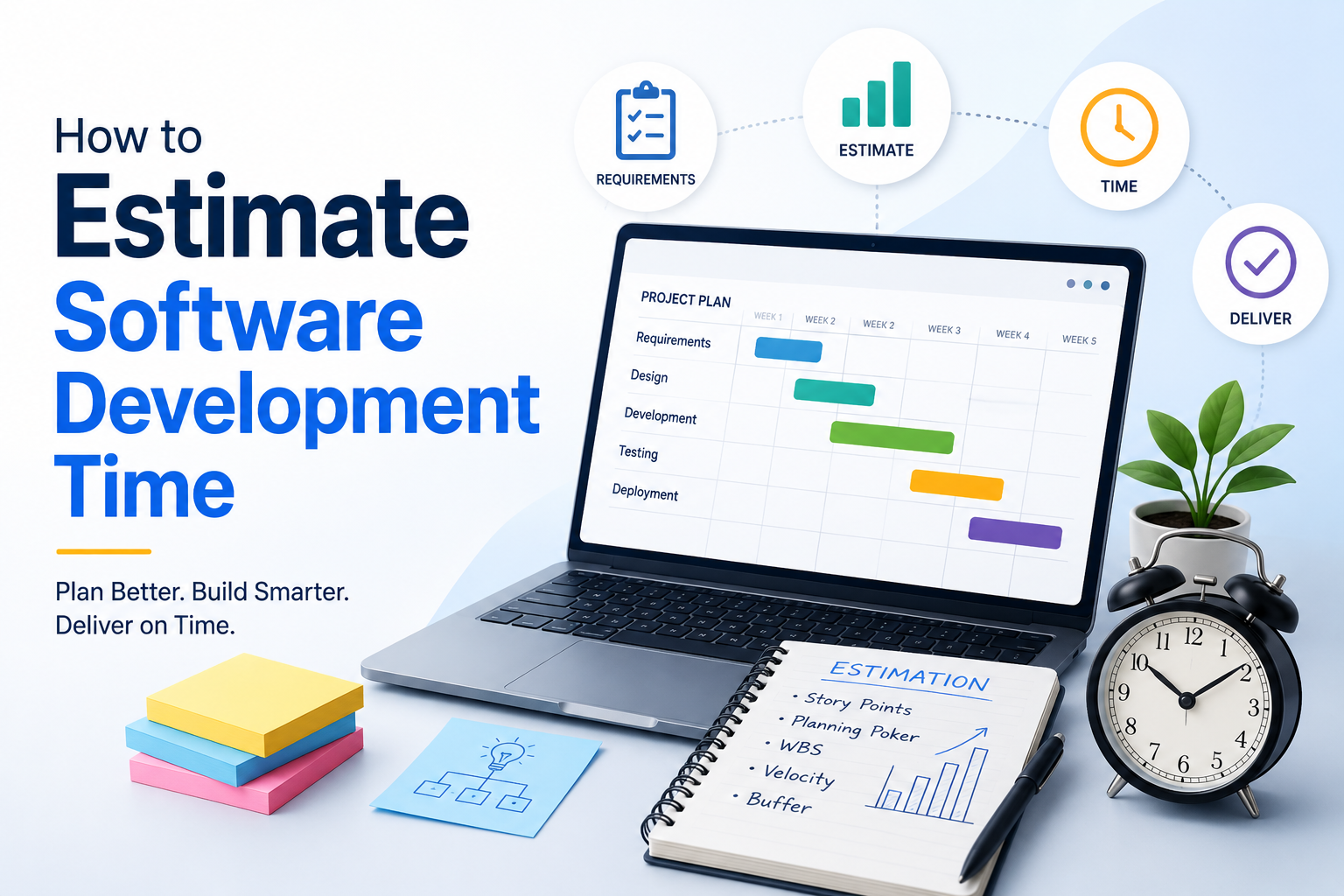
How to Estimate Software Development Time: A Practical Guide for Developers and Project Managers
One of the hardest questions in software development is surprisingly simple:
"How long will this take?"
Whether you're a freelancer, software engineer, project manager, or tech lead, you've probably been asked this question more times than you can count.
Unfortunately, software estimation is not about predicting the future.
It's about reducing uncertainty.
Many software projects don't fail because developers lack technical skills—they fail because timelines are unrealistic from the beginning.
A good estimate helps everyone make better decisions.
Clients understand what to expect.
Developers avoid unnecessary pressure.
Project managers create more realistic schedules.
In this guide, you'll learn practical estimation techniques used by successful software teams and discover common mistakes to avoid.
Why Software Estimation Matters

Software estimation is more than predicting how many days a task will take.
Good estimation helps teams:
Build realistic project schedules.
Allocate resources efficiently.
Reduce delivery risks.
Manage stakeholder expectations.
Improve sprint planning.
Prevent developer burnout.
Without estimation, every deadline becomes a guess.
Why Estimating Software Is Difficult
Unlike manufacturing, software development deals with uncertainty.
Every project includes unknown variables.
For example:
Changing client requirements
Technical complexity
Third-party API issues
Unexpected bugs
Team experience
Infrastructure limitations
Even experienced developers cannot predict every challenge.
That's why estimation should always include flexibility.
Start with Breaking Down the Work
One of the biggest mistakes is estimating an entire project as one large task.
Instead, divide the project into smaller pieces.
For example:
Online Booking System
Instead of estimating:
Build Booking System
Break it into:
User Authentication
User Dashboard
Booking Calendar
Payment Integration
Email Notification
Admin Dashboard
Reports
Testing
Deployment
Smaller tasks are much easier to estimate accurately.
Use the Work Breakdown Structure (WBS)
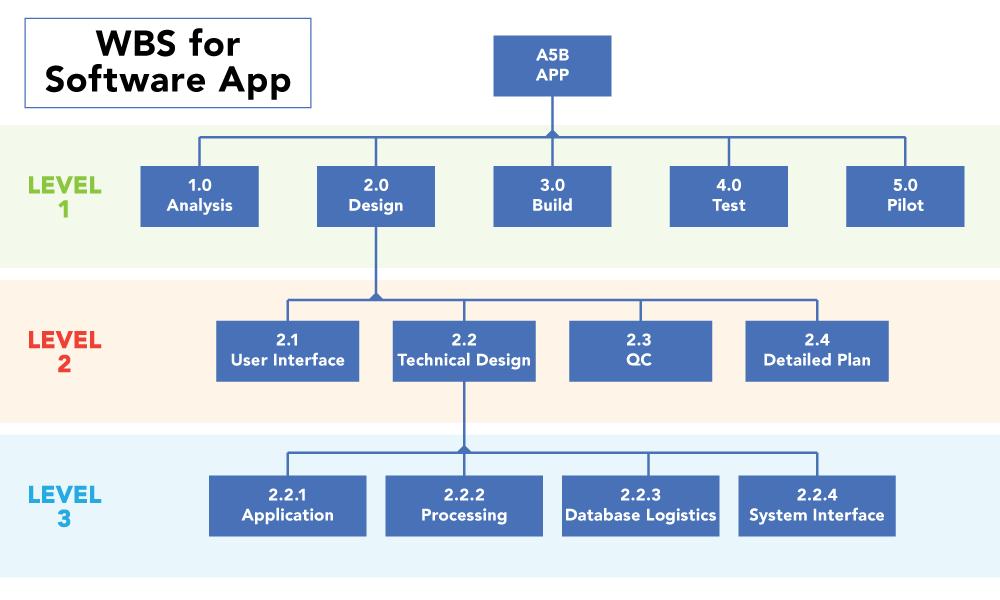
A Work Breakdown Structure (WBS) organizes a project into manageable components.
Example:
Software Project
├── Authentication
├── Dashboard
├── Payment
├── Notification
├── Reporting
├── Deployment
Instead of estimating one 200-hour project, you estimate many smaller tasks.
This significantly improves estimation accuracy.
Estimation Techniques Every Team Should Know
Different projects require different estimation methods.
Let's look at the most common techniques.
1. Expert Judgment
The simplest approach.
Experienced developers estimate based on previous projects.
Example:
"This login feature is similar to the one we built last month."
Advantages:
Fast
Practical
Easy
Disadvantages:
Subjective
Depends heavily on experience
2. Story Points
Story Points estimate complexity, not time.
Instead of asking:
"How many hours?"
Ask:
"How difficult is this compared to other tasks?"
Example:
Feature | Story Points |
|---|---|
Login Page | 2 |
Registration | 3 |
Shopping Cart | 8 |
Payment Gateway | 13 |
Story Points encourage teams to focus on effort instead of exact hours.
3. Planning Poker
Planning Poker is a collaborative estimation technique widely used in Scrum teams.
Each developer secretly selects an estimation card.
Typical values:
1
2
3
5
8
13
21
If estimates differ significantly, the team discusses why.
This often uncovers hidden technical challenges.
4. Three-Point Estimation
Instead of one estimate, create three.
Optimistic (O)
Most Likely (M)
Pessimistic (P)
Formula:
Estimated Time = (O + 4M + P) ÷ 6
Example:
Optimistic = 2 days
Most Likely = 4 days
Pessimistic = 8 days
Estimated Time
= (2 + 16 + 8) ÷ 6
≈ 4.3 days
This method accounts for uncertainty more effectively.
5. T-Shirt Sizing
Rather than using hours, classify tasks by size.
XS
S
M
L
XL
Example:
Bug Fix → XS
Login Feature → S
Payment Gateway → L
Migration Project → XL
This technique is useful during early project planning.
Consider Team Velocity
If your team uses Agile, don't estimate based on individual speed.
Estimate based on Team Velocity.
Example:
Average Sprint Velocity = 35 Story Points
If the backlog contains = 70 Story Points
The team will likely need = 2 Sprints
Velocity provides a more realistic planning baseline than individual estimates.
Don't Forget Buffer Time
Many beginners estimate only the coding work.
Real projects include much more.
Developers also spend time on:
Meetings
Code Reviews
Documentation
Testing
Deployment
Bug Fixes
Client Discussions
A practical recommendation is to include a 10–20% contingency buffer, depending on project complexity.
Buffer time isn't a sign of poor planning—it's a sign of realistic planning.
Common Estimation Mistakes
Avoid these common mistakes:
Estimating without understanding the requirements.
Ignoring technical risks.
Forgetting testing time.
Underestimating integrations with third-party services.
Assuming every developer works at the same speed.
Giving estimates under pressure.
Confusing optimism with accuracy.
The goal is not to promise the shortest timeline.
The goal is to deliver reliable expectations.
Best Practices
Successful software teams usually follow these principles:
Break work into smaller tasks.
Estimate collaboratively.
Learn from previous projects.
Review estimates after every Sprint.
Include testing and deployment.
Add contingency buffers.
Continuously improve estimation accuracy.
Software estimation is a skill that improves with experience.
Real-World Example
Imagine your team needs to build a Task Management application.
Instead of estimating:
Build Task Manager
Break it into:
Login (2 Story Points)
Dashboard (5 Story Points)
Task CRUD (8 Story Points)
Notification (5 Story Points)
Reports (8 Story Points)
Testing (5 Story Points)
Total:
33 Story Points
If your team's average velocity is 30 Story Points per Sprint, you already know the project will likely require slightly more than one Sprint.
This approach is far more reliable than simply saying,
"It should take about two weeks."
Why Good Estimates Build Trust
Clients don't expect developers to predict the future.
They expect transparency.
A well-explained estimate builds confidence because it demonstrates that the team understands:
Scope
Risks
Complexity
Dependencies
Delivery strategy
Accurate estimation is not just about numbers.
It's about communication.
Conclusion
Estimating software development time will never be perfect.
Technology changes.
Requirements evolve.
Unexpected challenges appear.
However, by using structured estimation techniques, breaking work into smaller tasks, collaborating as a team, and learning from previous projects, you can dramatically improve planning accuracy.
Remember:
Great software projects aren't delivered by guessing.
They're delivered through thoughtful planning, continuous learning, and realistic expectations.
Frequently Asked Questions
Should developers estimate in hours or Story Points?
For Agile teams, Story Points are generally preferred because they measure complexity rather than time. Hours are still useful for detailed scheduling and budgeting.
What is the best estimation technique?
There is no single best method. Many successful teams combine Story Points, Planning Poker, and historical velocity for the most accurate estimates.
Why are software estimates often inaccurate?
Because software projects involve uncertainty, changing requirements, technical challenges, and human factors that are difficult to predict precisely.