

Monolithic vs Microservices: Which Architecture Should You Choose?
Choosing the right software architecture is one of the most important decisions when building an application. Two of the most common architectural styles are Monolithic Architecture and Microservices Architecture.
Both approaches have their strengths and weaknesses. While many developers believe microservices are always the better choice, the reality is that the best architecture depends on your project's size, team, business goals, and expected growth.
In this guide, you'll learn the key differences between monolithic and microservices architectures, their advantages and disadvantages, real-world examples, and practical recommendations for choosing the right approach.
What Is a Monolithic Architecture?
A Monolithic Architecture is a traditional software architecture where all application components are built and deployed as a single unit.
Typical components include:
User Interface
Business Logic
Authentication
Database Access
API Endpoints
Background Jobs
Everything lives in one codebase and is deployed together.
Simple Monolithic Structure
Application
│
├── Authentication
├── Product Module
├── User Module
├── Payment Module
├── Admin Panel
└── Database
This approach is common in startups and small-to-medium applications because it is simple to develop and deploy.
Advantages of Monolithic Architecture
Simple Development
Developers only need one repository and one deployment pipeline.
Easier Debugging
Tracing errors is generally easier because everything runs in one application.
Better Performance
Internal function calls are faster than network communication between services.
Lower Infrastructure Cost
Only one application server is typically required during the early stages.
Faster MVP Development
Perfect for validating business ideas quickly.
Disadvantages of Monolithic Architecture
Large codebases become difficult to maintain.
Small changes require redeploying the entire application.
Scaling individual modules is impossible.
Technology upgrades become more challenging over time.
Team collaboration may become slower as the project grows.
What Is Microservices Architecture?
A Microservices Architecture divides an application into multiple small, independent services. Each service focuses on a single business capability and communicates with others through APIs or messaging systems.
Example services include:
Authentication Service
Product Service
Order Service
Payment Service
Notification Service
Each service can be developed, deployed, and scaled independently.
How Microservices Work
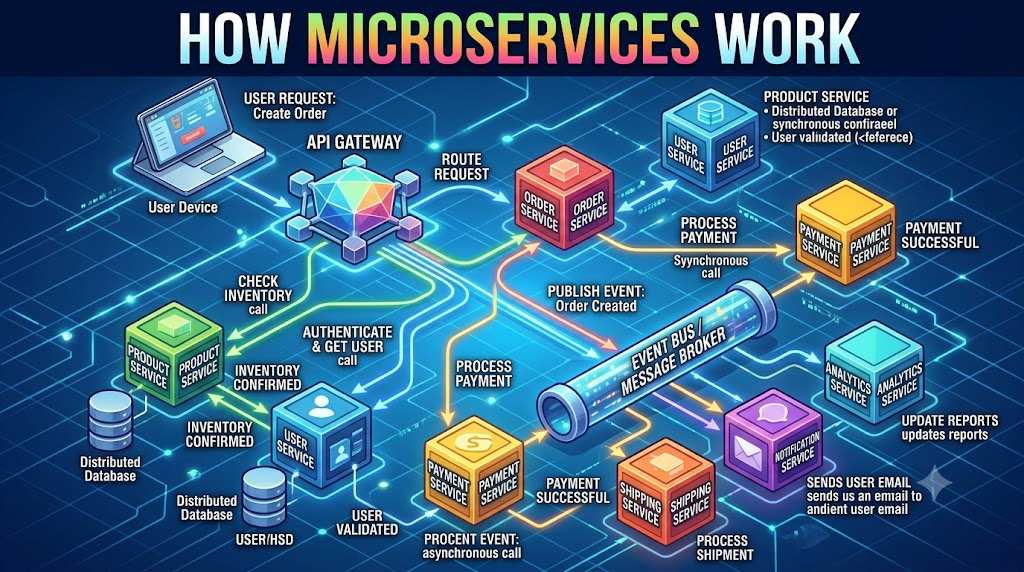
Client
│
API Gateway
│
├── User Service
├── Product Service
├── Payment Service
├── Order Service
└── Notification Service
Instead of one large application, many smaller services collaborate to deliver the complete system.
Advantages of Microservices
Independent Deployment
Teams can deploy one service without affecting the rest of the application.
Better Scalability
Only heavily used services need additional resources.
Example:
Payment Service receives high traffic.
Product Service receives normal traffic.
Only the Payment Service is scaled.
Technology Flexibility
Different services may use different programming languages or frameworks.
For example:
Authentication → Go
Product → Java
Recommendation Engine → Python
Frontend API → Node.js
Smaller Codebases
Each team manages a smaller, easier-to-understand project.
Improved Fault Isolation
If one service fails, the rest of the application can often continue operating.
Disadvantages of Microservices
Microservices introduce additional complexity.
Common challenges include:
Distributed systems management
Service discovery
API communication
Monitoring
Logging
Network latency
Data consistency
Security between services
These challenges require experienced engineering teams and robust infrastructure.
Monolithic vs Microservices Comparison
Feature | Monolithic | Microservices |
|---|---|---|
Deployment | Single deployment | Independent deployments |
Codebase | One repository | Multiple repositories (or modular mono-repo) |
Scalability | Entire application | Individual services |
Complexity | Low | High |
Infrastructure | Simple | Complex |
Development Speed | Fast for small teams | Better for large teams |
Maintenance | Harder as the app grows | Easier with clear service boundaries |
Technology Stack | Usually one | Multiple technologies possible |
Fault Isolation | Low | High |
Performance Comparison
Many developers assume microservices are always faster.
In reality:
Monolithic
Faster internal communication
Lower network overhead
Better for low-latency applications
Microservices
Slight network overhead
Better horizontal scalability
More resilient for large-scale systems
Performance depends on architecture quality—not just the chosen style.
When Should You Choose Monolithic?
A monolithic architecture is often the right choice when:
Building an MVP
Developing a startup product
Working with a small team
Managing a simple business application
Creating internal company tools
Launching quickly with limited infrastructure
Examples include:
Company websites
School management systems
Portfolio websites
Small e-commerce platforms
Booking applications
When Should You Choose Microservices?
Microservices become valuable when:
Your application has millions of users.
Multiple teams work simultaneously.
Services require independent scaling.
High availability is essential.
Frequent deployments are needed.
Different domains have distinct business logic.
Examples include:
Large e-commerce platforms
Video streaming services
Banking systems
Ride-hailing platforms
Global SaaS products
Real-World Examples
Many well-known companies have adopted microservices as they scaled:
Netflix
Amazon
Uber
Spotify
However, most of these companies started with a monolithic architecture before transitioning to microservices as their systems and teams grew.
This highlights an important lesson: you don't need microservices from day one.
Common Misconceptions
"Microservices Are Always Better"
Not true.
For many projects, microservices add unnecessary complexity.
"Monoliths Don't Scale"
Also not true.
Many successful applications scale effectively using a well-designed monolith.
"Large Companies Started with Microservices"
Most didn't.
They began with monoliths and evolved their architecture over time.
Best Practices
Regardless of which architecture you choose:
Design clear module boundaries.
Follow SOLID principles.
Write automated tests.
Use version control effectively.
Document architectural decisions.
Monitor application performance.
Refactor regularly as the system evolves.
Good architecture is about solving business problems, not following trends.
Which Architecture Should You Choose?
Here are some practical recommendations:
Choose Monolithic if:
You're a solo developer.
You're building your first product.
Your team has fewer than 10 developers.
You need to release quickly.
Infrastructure costs are limited.
Choose Microservices if:
Your application is growing rapidly.
Multiple teams own different domains.
Independent deployments are required.
Different services have different scaling needs.
You have the operational experience to manage distributed systems.
Remember, architecture should evolve with your business—not ahead of it.
Conclusion
There is no universal winner in the Monolithic vs Microservices debate.
A monolithic architecture offers simplicity, faster development, and lower operational costs, making it ideal for startups, MVPs, and smaller applications.
Microservices provide flexibility, scalability, and independent deployments, making them well-suited for large, complex systems with multiple development teams.
The best choice depends on your project's current needs, team size, and long-term goals. Start simple, design thoughtfully, and evolve your architecture as your application grows.
Frequently Asked Questions (FAQ)
Is Monolithic Architecture outdated?
No. Monolithic architecture is still widely used and remains an excellent choice for many applications, especially startups and internal business systems.
Is Microservices Architecture better for every project?
No. Microservices introduce operational complexity and should only be adopted when their benefits outweigh the additional overhead.
Can I migrate from Monolithic to Microservices later?
Yes. Many successful companies started with a monolith and gradually extracted services as their systems and teams expanded.
Which architecture should beginners learn first?
Beginners should first understand Monolithic Architecture because it teaches core software design concepts before moving on to the additional complexity of microservices.