
REST API vs GraphQL: Which API Architecture Should You Choose?
API (Application Programming Interface) is the backbone of modern software applications. Whether you're building a mobile app, SaaS platform, e-commerce website, or enterprise system, APIs enable communication between clients and servers.
Among the most widely used API architectures today are REST API and GraphQL. While both allow applications to exchange data efficiently, they differ significantly in how they handle requests, responses, flexibility, and performance.
So, which one should you choose?
In this guide, we'll compare REST API vs GraphQL, explore their strengths and weaknesses, discuss real-world use cases, and help you determine which approach best fits your next project.
What Is a REST API?

A REST API (Representational State Transfer) is an architectural style for designing web services that communicate over HTTP.
In REST, each resource is represented by a URL (endpoint).
For example:
GET /users
GET /users/15
GET /products
POST /orders
PUT /orders/25
DELETE /orders/25
Each endpoint typically returns data in JSON format.
REST has become the industry standard because it is simple, predictable, and widely supported.
How REST API Works
A client sends an HTTP request to a specific endpoint.
Example:
GET /users/15
Response:
{ "id": 15, "name": "John Doe", "email": "john@example.com"}Every resource usually has its own endpoint.
Advantages of REST API
Simple to Learn
REST follows standard HTTP methods:
GET
POST
PUT
PATCH
DELETE
Developers can quickly understand and implement RESTful APIs.
Excellent Tool Support
REST is supported by virtually every programming language, framework, and API testing tool.
Examples include:
Postman
Insomnia
Swagger/OpenAPI
cURL
Cache-Friendly
REST integrates well with HTTP caching mechanisms, improving performance for frequently requested resources.
Mature Ecosystem
Because REST has been around for many years, documentation, tutorials, and community support are extensive.
Disadvantages of REST API
REST isn't perfect.
Common challenges include:
Over-fetching
Clients sometimes receive more data than needed.
Example:
GET /users/15
Response:
{ "id":15, "name":"John", "email":"...", "address":"...", "phone":"...", "created_at":"...", "updated_at":"..."}If the client only needs the user's name, the remaining data is unnecessary.Under-fetching
A client may need data from multiple endpoints.
For example:
GET /users/15
GET /orders?user=15
GET /payments?user=15
This increases the number of network requests.
What Is GraphQL?
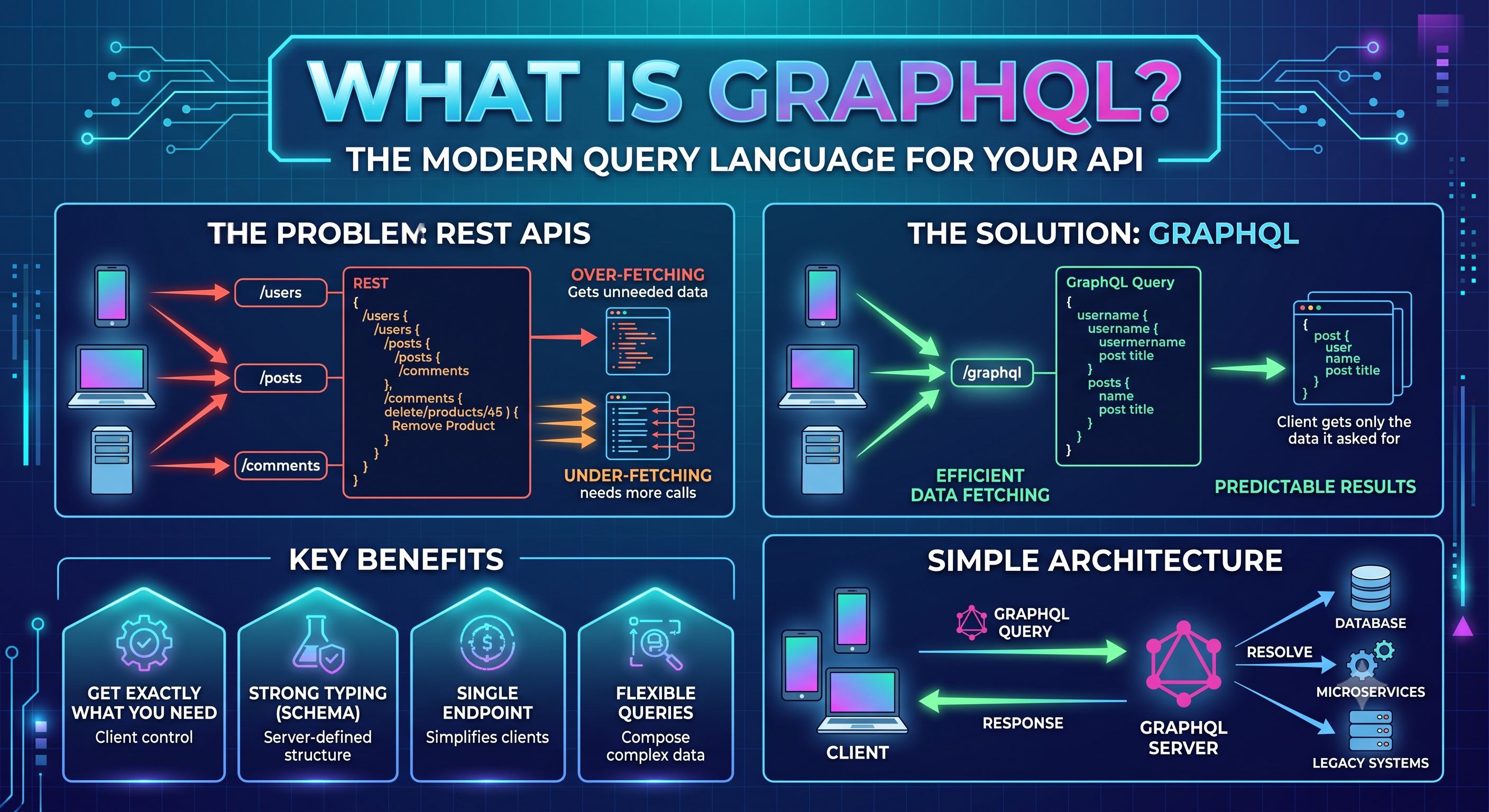
GraphQL is a query language and runtime for APIs originally developed by Meta.
Instead of exposing multiple endpoints, GraphQL typically exposes a single endpoint.
Example:
POST /graphql
The client specifies exactly which data it needs.
How GraphQL Works
Instead of calling multiple endpoints, the client sends a query.
Example:
query { user(id:15){ name email orders{ total status } }}Response:{ "data": { "user": { "name":"John", "email":"john@example.com", "orders":[ { "total":250, "status":"Completed" } ] } }}Only the requested fields are returned.Advantages of GraphQL
No Over-fetching
Clients receive exactly the data they request.
No Under-fetching
Related resources can be retrieved in a single request.
Faster Frontend Development
Frontend developers have greater flexibility without requiring backend changes for every data variation.
Strongly Typed Schema
GraphQL uses schemas that clearly define available queries and data types.
This improves documentation and developer experience.
Disadvantages of GraphQL
GraphQL introduces additional complexity.
Challenges include:
More difficult caching
Complex query optimization
Increased server-side implementation
More advanced security considerations
Potential performance issues from deeply nested queries
For small applications, GraphQL may be unnecessary.
REST API vs GraphQL Comparison
Feature | REST API | GraphQL |
|---|---|---|
Endpoints | Multiple | Single |
Data Fetching | Fixed responses | Client-defined |
Over-fetching | Possible | No |
Under-fetching | Possible | No |
Learning Curve | Easy | Moderate |
Caching | Excellent | More challenging |
Performance | Good | Excellent for complex queries |
Flexibility | Moderate | High |
Tooling | Mature | Growing rapidly |
Performance Comparison
Performance depends on the application.
REST
Advantages:
Simpler architecture
Effective HTTP caching
Lower server complexity
Ideal for:
CRUD applications
Internal business systems
Public APIs
GraphQL
Advantages:
Reduces unnecessary network requests
Returns only required data
Efficient for complex relationships
Ideal for:
Mobile applications
Large dashboards
Social media platforms
Data-rich applications
REST Example
Imagine an e-commerce application.
To display a customer's dashboard:
GET /customer
GET /orders
GET /wishlist
GET /notifications
The frontend makes four separate requests.
GraphQL Example
The same information can be retrieved with a single query:
query{ customer{ name orders{ total } wishlist{ productName } notifications{ title } }}Only one request is required.Security Considerations
Both REST and GraphQL require strong security practices.
Best practices include:
Authentication
Authorization
HTTPS
Rate limiting
Input validation
Logging
Monitoring
GraphQL additionally benefits from:
Query depth limits
Query complexity analysis
Persisted queries
These help protect against expensive or malicious queries.
Real-World Use Cases
REST API
REST is a great choice for:
E-commerce websites
Banking APIs
Payment gateways
Content Management Systems
Internal enterprise applications
Public APIs
GraphQL
GraphQL is well suited for:
Social media platforms
Mobile applications
Analytics dashboards
SaaS platforms
Real-time collaboration tools
Applications with highly connected data
REST API vs GraphQL: Which Should You Choose?
Choose REST API if:
You're building a standard CRUD application.
You want a simple and well-understood architecture.
HTTP caching is important.
Your team has limited GraphQL experience.
You're exposing a public API to many developers.
Choose GraphQL if:
Clients need flexible data retrieval.
You're building complex dashboards.
Mobile applications require optimized network usage.
Frontend teams need greater control over API responses.
Your application involves deeply connected data.
The best choice depends on your project's requirements rather than current technology trends.
Can REST and GraphQL Be Used Together?
Yes.
Many organizations combine both approaches.
For example:
Public APIs → REST
Internal dashboards → GraphQL
Mobile applications → GraphQL
Payment services → REST
This hybrid strategy allows teams to leverage the strengths of each architecture where appropriate.
Common Mistakes
Developers often make these mistakes:
Choosing GraphQL simply because it's popular.
Creating too many REST endpoints without proper resource design.
Ignoring API versioning.
Returning excessive data.
Skipping authentication and rate limiting.
Designing APIs without considering future scalability.
Focus on solving real business needs instead of following trends.
Best Practices
Whether you choose REST or GraphQL, follow these guidelines:
Design APIs around business resources.
Keep responses consistent.
Implement authentication and authorization.
Validate all incoming requests.
Document your API thoroughly.
Monitor API performance.
Write automated tests.
Version your API when introducing breaking changes.
Good API design prioritizes simplicity, consistency, and maintainability.
Conclusion
The REST API vs GraphQL debate doesn't have a single winner.
REST remains an excellent choice for most web applications due to its simplicity, mature ecosystem, and strong support for caching and standard HTTP practices.
GraphQL offers greater flexibility by allowing clients to request exactly the data they need, making it particularly valuable for complex applications with rich, interconnected data models.
Rather than asking which technology is "better," ask which one best supports your application's requirements, your team's expertise, and your long-term architecture goals.
Frequently Asked Questions (FAQ)
What is the main difference between REST API and GraphQL?
REST uses multiple endpoints with predefined responses, while GraphQL typically uses a single endpoint where clients specify exactly which data they want.
Is GraphQL faster than REST?
Not necessarily. GraphQL can reduce network requests for complex data retrieval, while REST may perform better for simple operations and benefits from built-in HTTP caching.
Should beginners learn REST or GraphQL first?
REST is the better starting point because it introduces fundamental API concepts, HTTP methods, resource design, and status codes before moving on to GraphQL.
Can I use both REST and GraphQL in the same application?
Yes. Many organizations adopt a hybrid approach, using REST for straightforward services and GraphQL where flexible, client-driven data retrieval provides clear advantages.