Have you ever received five different tasks and been told:
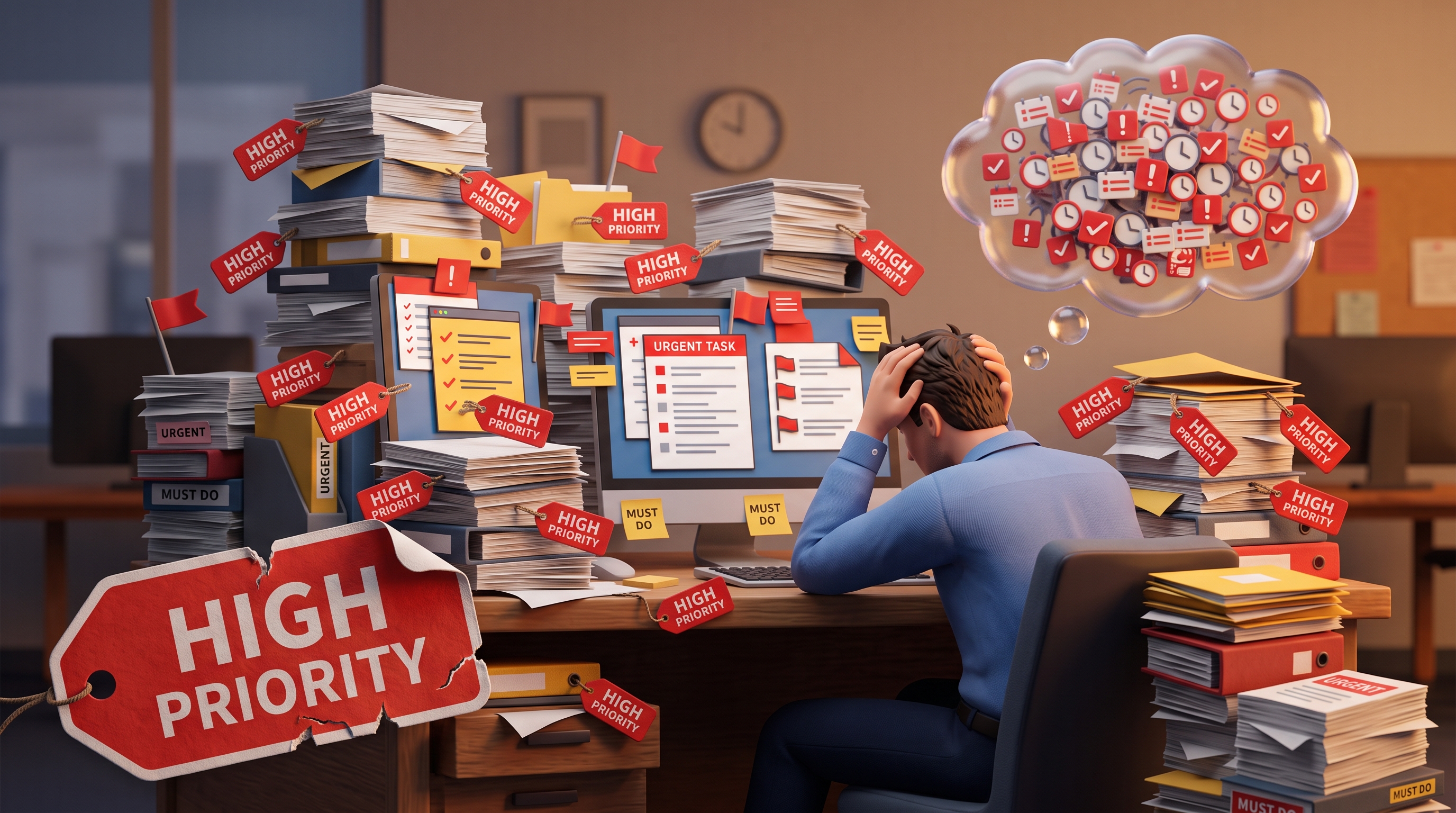
“They're all high priority.”
At first, you probably think:
“Okay, I'll work on them.”
Then another request arrives.
“This one is also urgent.”
Then another:
“Actually, this one needs to be done today.”
Suddenly, everything is high priority.
And when everything is high priority...
Nothing really is.
This sounds like a small project management problem, but it can create some surprisingly serious consequences.
Teams lose focus.
Deadlines become meaningless.
Developers keep switching between tasks.
Stakeholders become frustrated.
And eventually, everyone feels busy without necessarily moving the project forward.
So why does this happen?
And how can teams manage priorities more effectively?
Let's talk about it.
What Does “High Priority” Actually Mean?
The word priority should tell us something important:
Not everything can have the same priority.
If ten tasks are all labeled “High,” the label stops providing useful information.
Imagine a hospital where every patient is marked:
Critical.
The label wouldn't help doctors decide who needs attention first.
Project management works the same way.
A priority is useful only when it helps the team answer:
“What should we work on first?”
If the answer is:
“Everything.”
Then you don't really have a priority system.
You have a list of requests.
Why Does Everything Become High Priority?
There are several reasons.
Someone Is Shouting the Loudest
Sometimes the loudest stakeholder gets the fastest response.
A person sends a message:
“Can this be fixed ASAP?”
Another stakeholder sends:
“We really need this today.”
The team reacts to whoever speaks with the most urgency.
The problem is that urgency and importance are not always the same thing.
A task can feel urgent because someone is asking loudly, while another task may be much more important to the business.
Nobody Defines the Criteria
Sometimes the team has never agreed on what “high priority” actually means.
Does it mean:
Important to revenue?
Blocking a release?
Affecting customers?
Security-related?
Needed by management?
Needed today?
Without a clear definition, everyone creates their own.
And suddenly every request becomes “high priority.”
Stakeholders Don't Want to Take Risks
Another reason is fear.
A stakeholder might think:
“If I call this high priority, the team will pay more attention to it.”
So they label everything as urgent.
It becomes a defensive strategy.
Nobody wants their request to be placed at the bottom of the list.
But when everyone does it, the prioritization system collapses.
The Hidden Cost of Too Many “High Priority” Tasks
Calling everything high priority isn't just annoying.
It has real consequences.
1. Teams Lose Focus
Imagine a developer starts working on Task A.
Twenty minutes later:
“Stop. Task B is more urgent.”
Then:
“Actually, Task C needs attention.”
Then:
“Can you quickly check Task D?”
The developer is constantly switching contexts.
The result?
A lot of activity.
Not necessarily a lot of progress.
2. Context Switching Becomes Expensive
Software development requires concentration.
A developer may need time to understand:
Business logic
Existing code
Dependencies
Data flow
Technical constraints
When they suddenly switch to another problem, they lose that mental context.
When they return to the original task, they have to rebuild it.
That invisible overhead can significantly reduce productivity.
3. Real Emergencies Become Harder to Spot
This is one of the biggest problems.
Suppose every ticket is marked:
HIGH
Then one day a genuinely critical issue appears.
For example:
“Production payments are failing.”
But the team sees another:
HIGH
and another:
HIGH
and another:
HIGH
The truly critical incident no longer stands out.
When everything looks urgent, the team struggles to recognize what actually requires immediate action.
4. Deadlines Lose Meaning
Imagine the project manager says:
“Feature A is high priority.”
Then:
“Feature B is also high priority.”
Then:
“Feature C must be done before Friday.”
But the team only has enough capacity for two of them.
Now someone has to choose.
But the priority labels haven't provided enough information to make that decision.
The team ends up negotiating priorities after the work has already started.
That's inefficient.
5. Teams Start Working on What Is Loudest
Eventually, people stop trusting the formal priority system.
Instead, they look at:
Slack messages
Emails
Meetings
Direct messages
Escalations
Whoever creates the most noise gets attention.
That's a dangerous way to run a project.
High Priority Does Not Mean “Do This First”
This is an important distinction.
A task can be high priority while still being scheduled for later.
For example:
A security improvement may be strategically important but not need to be completed today.
Meanwhile:
A production outage may require immediate action.
Both are important.
But their urgency is different.
This is why a useful priority framework often considers at least two dimensions:
Importance
How much does this matter?
Urgency
How quickly does it need attention?
Those aren't always the same thing.
A Simple Priority Framework
One practical approach is to classify work into categories such as:
Priority | Meaning | Example |
|---|---|---|
P0 / Critical | Immediate business or system impact | Production outage |
P1 / High | Important and time-sensitive | Release blocker |
P2 / Medium | Valuable but can be scheduled | Important feature |
P3 / Low | Useful but not urgent | Nice-to-have improvement |
The exact naming doesn't matter.
Your organization might use:
Critical / High / Medium / Low
or:
P0 / P1 / P2 / P3
or another system entirely.
What matters is that everyone understands what each level means.
A Better Question Than “Is This High Priority?”
When someone asks:
“Can you mark this as high priority?”
Instead of immediately saying yes, ask:
“What happens if we don't do this now?”
This is a powerful question.
The answer often reveals the real priority.
For example:
“If we don't fix it today, the entire checkout process stops.”
That's probably critical.
Compare that with:
“It would be nice to have this before the next management meeting.”
Maybe important.
But probably not critical.
The question shifts the conversation from emotion to impact.
Prioritization Should Be Based on Impact
A good priority system should consider the consequences of delaying a task.
Ask things like:
Customer Impact
How many users are affected?
Business Impact
Does it affect revenue or operations?
Risk
Could delaying it create security, compliance, or technical risk?
Dependency
Is another project blocked by this task?
Deadline
Is there a real external deadline?
Effort
How much work is required?
This doesn't need to become a complicated mathematical formula.
Sometimes simply asking these questions is enough to improve prioritization.
Use “Must Have” vs “Nice to Have”
Another simple approach is separating requirements into:
Must Have
Without this, the release doesn't work.
Should Have
Important, but the project can continue without it.
Could Have
Useful, but not essential.
Won't Have — For Now
Good idea, but intentionally postponed.
This type of thinking can help teams avoid treating every requested feature as equally important.
Don't Confuse the Requester With the Priority
This is a subtle but important lesson.
The person requesting something doesn't automatically determine its priority.
A senior executive might ask for a feature.
A junior support agent might report a production issue.
The support issue could still be more urgent.
Priority should be based on impact and context, not organizational volume.
That can be uncomfortable.
But it's necessary for healthy project management.
What Project Managers Can Do
Project managers and product owners play an important role here.
They can help by:
Defining priority criteria
Everyone should understand what makes something critical.
Maintaining a visible backlog
Keep upcoming work organized instead of relying on scattered messages.
Making trade-offs explicit
If a new high-priority item appears, ask:
“What are we moving down to make room for it?”
This is one of the most useful questions in project management.
Because adding priority should usually mean changing another priority.
Capacity doesn't magically increase.
What Developers Can Do
Developers also have a role.
When receiving an “urgent” request, don't be afraid to ask:
“What is the business impact?”
or:
“What happens if we deliver this next week instead of today?”
These aren't confrontational questions.
They're clarification questions.
Developers can also explain technical consequences.
For example:
“We can work on this today, but it will delay the payment integration by two days.”
Now the stakeholder can make an informed decision.
That is much healthier than silently accepting everything.
Priority Changes Should Be Visible
Changing priorities is normal.
Projects evolve.
Customers provide new feedback.
Production incidents happen.
Business goals change.
The problem isn't changing priorities.
The problem is changing them without acknowledging the trade-off.
If Feature A moves from P2 to P0, someone should understand what happens to Feature B.
For example:
“We are moving the production issue to P0. As a result, the analytics feature will move to next sprint.”
That simple statement makes the trade-off visible.
One Simple Rule: Every Priority Has a Cost
This may be the most useful principle in the entire discussion.
Every time you make something more important, something else becomes relatively less important.
You can't simply increase the number of “top priorities.”
You only have so much:
Time
People
Budget
Attention
Capacity
Priority is ultimately about deciding where limited resources should go first.
What Good Prioritization Looks Like
A healthy team can look at its backlog and quickly answer:
“What should we be working on right now?”
Everyone understands:
Why it matters
What comes next
What can wait
Who made the decision
What trade-off was accepted
That clarity reduces unnecessary debate.
It also helps developers focus on actually building things.
The Goal Isn't to Have Fewer Priorities
This is an important nuance.
The goal isn't to artificially make everything low priority.
Some projects really do have multiple urgent problems.
The goal is to differentiate between them.
You might have:
1 Critical
3 High
8 Medium
20 Low
That's very different from:
32 High
The first system gives the team a signal.
The second creates noise.
Final Thoughts
Calling everything “high priority” might feel like a way to make sure nothing gets ignored.
But ironically, it can have the opposite effect.
When every task is urgent, teams lose focus.
When every ticket is high priority, real emergencies become harder to identify.
When every request jumps to the top, deadlines become harder to manage.
And when every stakeholder believes their request is number one, the project becomes a constant negotiation.
Good prioritization isn't about making everyone happy.
It's about making clear trade-offs.
Sometimes the most important project management decision isn't deciding what to do.
It's deciding:
“What are we intentionally not doing right now?”
Because when everything is a priority...
priority stops meaning anything.
Need Help Bringing Structure to a Growing Software Project?
When projects grow, priorities can become difficult to manage—especially when product requirements, technical constraints, deadlines, and stakeholder expectations start competing with each other.
I work across software development, backend systems, API integration, software architecture, and technical project planning, and I'm open to freelance projects, consulting, and technical collaborations.
If you're building a product, improving an existing system, or struggling to turn a long list of requirements into a realistic technical plan, let's talk.
Have a project in mind? Let's turn the priorities into a plan that your team can actually execute.
How does your team handle priorities? Do you have a clear system, or does everything somehow become “high priority”?