

What Is Software Architecture? A Beginner's Guide
Software development is much more than writing code. As applications grow larger, supporting thousands or even millions of users, developers need a structured way to organize systems that are maintainable, scalable, and reliable. This is where software architecture becomes one of the most important concepts every developer should understand.
Whether you're building a personal portfolio website, an e-commerce platform, or an enterprise banking system, software architecture serves as the blueprint that guides how every component works together.
In this guide, you'll learn what software architecture is, why it matters, common architectural patterns, and how beginners can start thinking like an architect.
What Is Software Architecture?

Software architecture is the high-level structure of a software system. It defines how different components interact, communicate, and work together to achieve business goals.
Think of software architecture like the blueprint of a building.
Before constructing a skyscraper, architects determine:
Foundation
Structural design
Electrical systems
Plumbing
Safety systems
Similarly, software architects decide:
How services communicate
Database design
API interactions
Security strategies
Scalability approach
Deployment strategy
Developers then implement these architectural decisions through code.
Why Is Software Architecture Important?
A good architecture makes software easier to:
Maintain
Scale
Test
Secure
Deploy
Extend with new features
Without proper architecture, projects often become difficult to manage as they grow.
Imagine building an application without any planning. At first, everything seems fine. But after months of development, adding even a simple feature may require modifying dozens of files because responsibilities are mixed together.
Good architecture helps avoid this situation.
Key Components of Software Architecture
1. Presentation Layer
The user interface where users interact with the application.
Examples:
React
Vue
Angular
Flutter
Responsibilities:
Display information
Handle user input
Send API requests
2. Business Logic Layer
Contains the application's core functionality.
Examples:
Authentication
Payment processing
Order calculation
Inventory validation
This layer represents the business rules of your application.
3. Data Layer
Responsible for storing and retrieving data.
Examples:
MySQL
PostgreSQL
MongoDB
Redis
Responsibilities include:
CRUD operations
Database optimization
Transactions
4. Infrastructure Layer
Supports communication with external systems.
Examples:
Email services
Cloud storage
Third-party APIs
Message queues
Simple Software Architecture Flow
User
│
▼
Frontend (React)
│
▼
REST API
│
▼
Business Logic
│
▼
Database
Each layer has a specific responsibility, making the application easier to maintain.
Common Software Architecture Patterns
1. Layered Architecture

The most common architecture for business applications.
Advantages
Easy to understand
Beginner-friendly
Good separation of concerns
Disadvantages
Can become tightly coupled
Harder to scale in very large systems
2. Clean Architecture
Popularized by Robert C. Martin (Uncle Bob).
The main principle:
Business logic should not depend on frameworks, databases, or external libraries.
Benefits include:
Easier testing
Better maintainability
Framework independence
Long-term scalability
This architecture is widely used in enterprise applications and modern backend frameworks.
3. Microservices Architecture
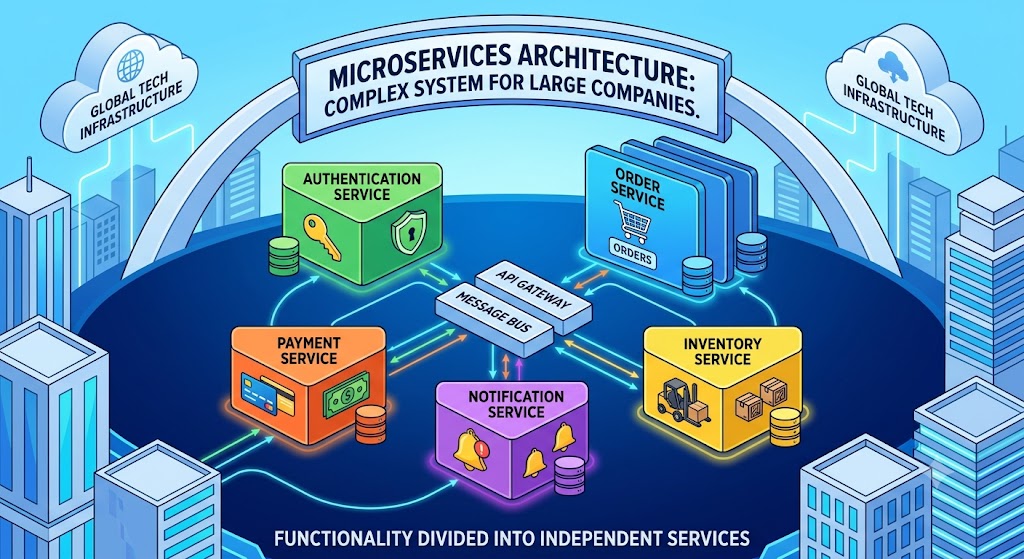
Instead of one large application, functionality is divided into independent services.
Example:
Authentication Service
Order Service
Payment Service
Notification Service
Inventory Service
Each service can be developed, deployed, and scaled independently.
Large companies often adopt this approach for complex systems.
4. Event-Driven Architecture
Components communicate using events instead of direct calls.
Example:
Customer places order
│
▼
Order Created Event
│
├── Email Service
├── Inventory Service
├── Analytics
└── Shipping
This approach improves scalability and decouples services.
Software Architecture vs System Design
Many beginners confuse these two concepts.
Software Architecture | System Design |
|---|---|
Overall blueprint | Detailed implementation |
Defines structure | Defines components |
Long-term planning | Technical execution |
Focuses on organization | Focuses on optimization |
In simple terms:
Architecture decides what the system looks like, while system design decides how each part works internally.
Software Architecture vs Clean Architecture
These terms are related but not identical.
Software Architecture is the broad discipline of designing software systems.
Clean Architecture is one specific architectural style within that discipline.
Other architectural styles include:
Layered Architecture
Hexagonal Architecture
Onion Architecture
Microservices
Event-Driven Architecture
Characteristics of Good Software Architecture
A well-designed architecture should have the following qualities:
Scalability
Can handle increasing users without major redesign.
Maintainability
Easy to update and modify.
Reliability
Continues operating correctly even when failures occur.
Security
Protects data and prevents unauthorized access.
Performance
Responds quickly and efficiently.
Testability
Supports automated testing with minimal effort.
Real-World Example
Imagine building an online bookstore.
Instead of putting everything into one file: book.php
You separate responsibilities:
Controllers
Services
Repositories
Models
Database
API
Authentication
Now each part has a clear purpose.
Later, if you add:
Wishlist
Reviews
Coupons
Recommendations
You won't need to rewrite the entire application.
Best Practices for Beginners
If you're learning software architecture, consider these guidelines:
Start with Layered Architecture.
Learn SOLID principles.
Separate business logic from UI.
Avoid tightly coupled components.
Keep modules focused on a single responsibility.
Write clean, readable code.
Use dependency injection where appropriate.
Document your architecture decisions.
Refactor regularly as requirements evolve.
Common Mistakes
Many beginners make these mistakes:
Putting all logic inside controllers
Mixing UI with business logic
Hardcoding database queries everywhere
Ignoring project structure
Overengineering small applications
Copying enterprise architectures unnecessarily
Remember:
Good architecture should solve real problems, not create unnecessary complexity.
When Should You Learn Software Architecture?
You don't need to wait until you're a senior developer.
Learning software architecture early helps you:
Write cleaner code
Understand large projects
Collaborate with teams
Build scalable applications
Prepare for technical interviews
Advance toward senior engineering roles
Even personal projects become more professional when built with a solid architectural foundation.
Conclusion
Software architecture is the foundation of every successful software project. It defines how different parts of an application work together, making systems easier to maintain, scale, and evolve over time.
As a beginner, focus on understanding the principles behind architectural decisions rather than memorizing patterns. Start with layered architecture, explore clean architecture, and gradually learn more advanced approaches like microservices and event-driven systems.
By investing time in software architecture today, you'll build applications that remain reliable and maintainable as they grow—an essential skill for every modern software engineer.
FAQ
What is software architecture?
Software architecture is the high-level design of a software system that defines its structure, components, and interactions.
Is software architecture different from system design?
Yes. Software architecture focuses on the overall structure and organization of a system, while system design focuses on the detailed implementation of its components.
Is Clean Architecture suitable for beginners?
Yes. Although it introduces additional concepts, learning Clean Architecture early helps developers write maintainable and testable code.
Which software architecture should I learn first?
Layered Architecture is an excellent starting point because it is simple, widely used, and easy to understand before moving on to more advanced patterns like Clean Architecture or Microservices.