
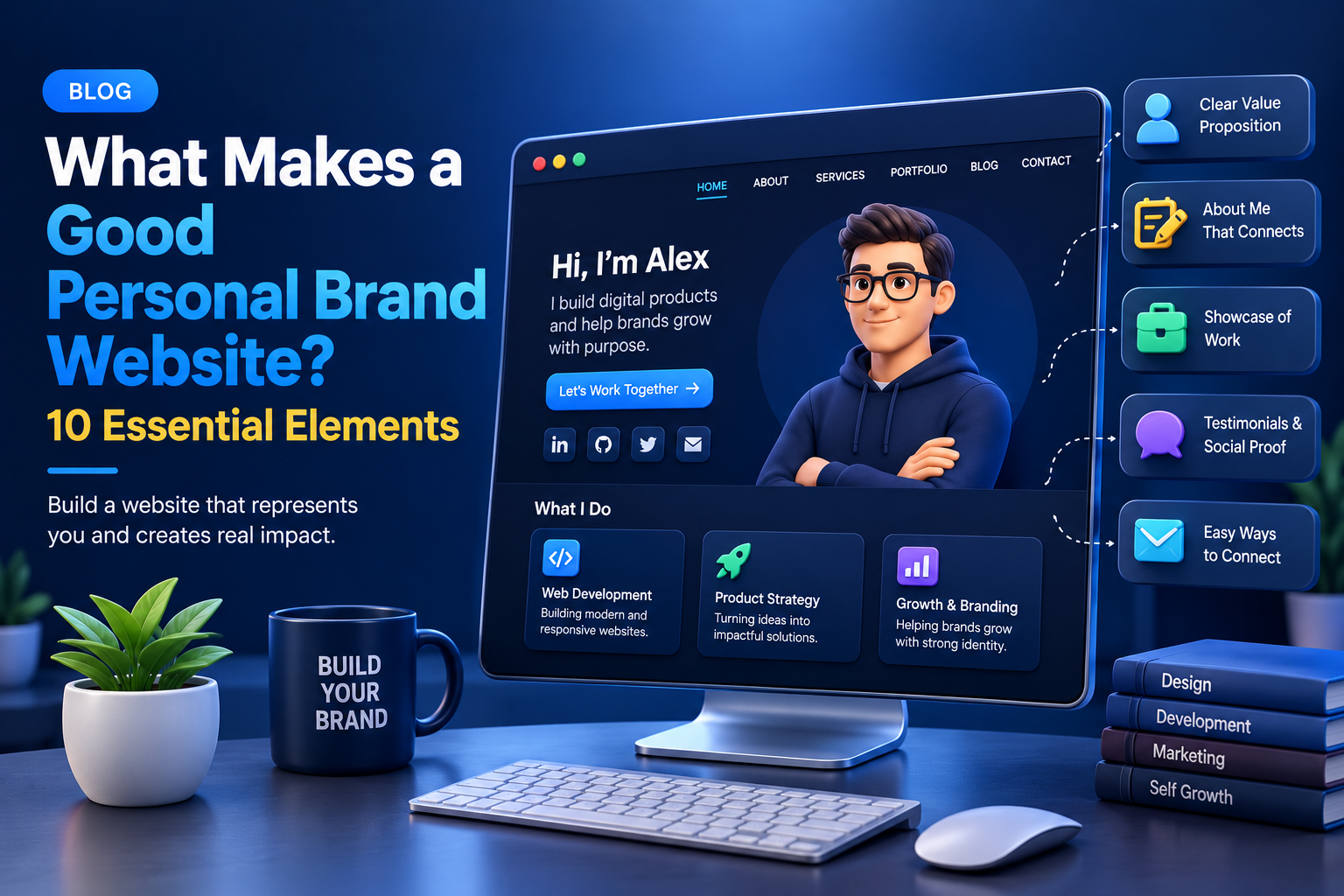
When someone searches your name on Google, what do you want them to find?
A LinkedIn profile?
An old social media account?
A random mention from five years ago?
Or a website that immediately tells people:
“This is who I am, this is what I do, and this is what I can help you with.”
That's the real value of a personal brand website.
Your website isn't just another online profile.
It can become your digital home—a place where your experience, skills, projects, ideas, and personality come together.
But having a website doesn't automatically mean you have a strong personal brand.
You can have a beautiful website that gets almost no engagement.
You can have an impressive portfolio that doesn't generate a single inquiry.
You can have great experience but make visitors spend five minutes trying to figure out what you actually do.
So, what makes a personal brand website good?
In my experience, it comes down to a combination of clarity, credibility, usability, and conversion.
Here are 10 essential elements worth considering.
1. A Clear Value Proposition
The first thing visitors should understand is:
Who are you, and what do you do?
Not after scrolling through five sections.
Not after reading your entire biography.
Ideally, they should understand it within a few seconds.
For example, instead of:
“Welcome to my website.”
Try something more specific:
Software Developer building scalable web applications, APIs, and digital products.
Or:
I help startups turn product ideas into reliable web applications.
The second version tells visitors much more.
A good value proposition should communicate:
Who you are + what you do + who you help or what outcome you create.
Don't make visitors guess.
2. A Strong About Section
Once people understand what you do, they usually want to know:
Who is this person?
This is where your About page or section matters.
But don't turn it into a copy of your resume.
A good personal brand story should explain:
Your background
Your experience
What you care about
What you specialize in
What you're currently working on
Where you want to go next
You can also make it more human.
Talk about lessons you've learned.
Mention the kinds of problems you enjoy solving.
Explain why you chose your field.
People connect with stories much more easily than lists of technologies.
3. A Portfolio That Shows Real Work
If you're a developer, designer, consultant, writer, or creative professional, your portfolio is one of the most important parts of your website.
But don't just create a grid of project names.
Show context.
For every important project, consider explaining:
The problem
What needed to be solved?
Your role
What did you actually do?
The approach
How did you solve it?
The technology
What tools or technologies did you use?
The outcome
What changed because of the work?
For example:
Challenge: The client needed a faster internal approval workflow.
Approach: Designed and developed a web-based workflow system with role-based access.
Result: Reduced manual steps and centralized the approval process.
Now the project tells a story.
That is much more valuable than:
“Laravel + React + MySQL.”
4. Social Proof and Credibility
It's one thing to tell visitors:
“I'm good at what I do.”
It's another thing when someone else says it.
This is where social proof becomes useful.
Depending on your profession, you can include:
Client testimonials
Recommendations
Case studies
Open-source contributions
Certifications
Publications
Speaking engagements
Awards
Companies you've worked with
You don't need to show everything.
Just show evidence that reinforces your positioning.
For example, a developer may have:
“Built APIs and backend systems for internal enterprise applications.”
That becomes more credible when supported by a case study or project example.
5. A Professional but Personal Design
A personal brand website should look professional.
But it shouldn't feel like a generic corporate website.
Your website should reflect you.
That can come through:
Typography
Layout
Photography
Writing style
Color choices
Illustrations
Micro-interactions
Project presentation
The key is consistency.
You don't need 20 animations to create personality.
Sometimes a clean layout, strong typography, and thoughtful writing are enough.
And remember:
Design should support your message—not compete with it.
A beautiful website that makes it difficult to find your portfolio isn't a good personal brand website.
6. Easy Navigation
Visitors shouldn't have to solve a puzzle to understand your website.
A simple navigation might include:
Home
About
Projects
Blog
Contact
That's often enough.
Depending on your goals, you might also include:
Services
Case Studies
Resources
Resume
But avoid adding pages just because other websites have them.
Every navigation item should have a purpose.
A good rule is:
Make important information easy to find.
If someone wants to see your work, they shouldn't need to search for it.
7. A Blog That Shows How You Think
This is one of the most underrated parts of a personal brand website.
A portfolio shows:
What you've built.
A blog can show:
How you think.
For example, instead of simply saying:
“I understand API architecture.”
You could publish articles about:
API Gateway design
Webhooks
Authentication vs authorization
Database indexing
Load balancing
Software estimation
Stakeholder management
Now potential clients, recruiters, or collaborators can see your knowledge through your writing.
And over time, your blog can also attract organic search traffic.
This creates a powerful combination:
Expertise → Content → Search traffic → Trust → Opportunity
8. Strong Calls to Action
A personal brand website shouldn't make visitors wonder:
“What am I supposed to do next?”
That's where calls to action (CTAs) matter.
Depending on your goals, your CTA might be:
Let's Work Together
View My Projects
Book a Consultation
Start a Project
Read My Case Studies
Get in Touch
The important thing is that the CTA matches what you want visitors to do.
And don't put the CTA only on your Contact page.
A relevant CTA can appear after:
Your hero section
A portfolio project
A case study
A blog article
Your About section
Just don't turn every section into a sales pitch.
The CTA should feel like the natural next step.
9. Basic SEO Setup
A great website isn't very useful if nobody can find it.
That's why SEO for a personal website matters.
You don't need to become an SEO expert to get the basics right.
Start with:
Page Titles
Every important page should have a clear title.
Meta Descriptions
Write useful descriptions that explain what visitors can expect.
Clean URLs
For example:
/example.com/about
/example.com/projects
/example.com/blog/database-indexing
rather than complicated URLs full of parameters.
Useful Content
Publish content that answers questions your target audience actually searches for.
Internal Links
Connect related pages and articles.
For example:
Database Indexing
can link to:
Query Optimization
which can link to:
Backend Performance.
Technical SEO
Make sure your website is:
Mobile-friendly
Fast enough
Crawlable
Using HTTPS
Properly indexed
Free from unnecessary broken links
For a personal brand website, your name itself can also become an important search term.
That means your site should make it clear who you are.
10. A Simple Way to Contact You
This sounds obvious.
But many personal websites make contacting the owner surprisingly difficult.
Don't force someone to:
Find your contact page.
Fill out a long form.
Create an account.
Confirm their email.
Solve a CAPTCHA.
Wait for a response.
For a personal website, something as simple as:
Email me
can be enough.
You can also provide:
Contact form
LinkedIn
GitHub
X
Professional marketplace profile
But make the primary path obvious.
If you're trying to attract freelance work, make it easy for a potential client to reach you while their interest is still high.
Bonus: Your Website Should Feel Like You
This is probably the most important element that doesn't appear in a checklist.
A personal brand website shouldn't feel like a template filled with your name.
Your personality should show up in the:
Writing.
Project stories.
Visual style.
Opinions.
Experiences.
You don't need to overshare.
But visitors should get a sense that there's a real person behind the website.
That's especially useful when you're trying to attract freelance clients or collaborators.
People aren't only choosing your technical skills.
They're also choosing:
“Do I want to work with this person?”
Your website can help answer that question before the first call ever happens.
What a Strong Personal Brand Website Should Answer
A visitor should be able to answer these questions quickly:
Who are you?
Your positioning should be obvious.
What do you do?
Your services or expertise should be clear.
What have you built?
Your portfolio should provide evidence.
Do you know what you're talking about?
Your content, case studies, and social proof should demonstrate expertise.
Why should I trust you?
Your experience and evidence should reduce uncertainty.
What should I do next?
Your CTA should make the next step clear.
If your website answers all six, you're already ahead of many personal websites.
A Simple Personal Brand Website Structure
For many professionals, a structure like this is enough:
Home
 ├── Hero / Value Proposition
 ├── About
 ├── Featured Projects
 ├── Services / Expertise
 ├── Social Proof
 ├── Latest Articles
 └── CTA

About
Projects
Blog
Contact
You don't need a massive website.
You need a clear one.
Common Personal Brand Website Mistakes
A few mistakes appear again and again.
Making the Homepage About Everything
Trying to show every skill, project, hobby, and achievement makes the message weaker.
Focusing Too Much on Design
A beautiful interface doesn't compensate for unclear positioning.
Writing a Generic About Page
“I am passionate about technology and innovation.”
Almost everyone says that.
Be specific.
Having No Clear CTA
Don't make visitors figure out how to work with you.
Showing Skills Without Evidence
Listing:
React, Node.js, AWS, Docker, Laravel...
isn't as powerful as showing what you actually built with them.
Never Updating the Website
Your website should evolve as your career evolves.
An outdated portfolio sends the wrong signal.
Final Thoughts
A good personal brand website isn't necessarily the most visually impressive website.
It's the one that makes your value easy to understand and easy to trust.
It should answer the basic questions:
Who are you?
What do you do?
What have you built?
Why should someone trust you?
How can they work with you?
The best personal websites combine clarity, credibility, content, and conversion.
And perhaps the biggest mistake is trying to make your website look like everyone else's.
Your personal brand is personal for a reason.
Use your website to show not only what you can build, but how you think, what you care about, and why someone should choose to work with you.
Because a great personal brand website doesn't just say:
“Here is my resume.”
It says:
“Here is who I am, here is what I can do, and here is what we could build together.”
Thinking About Building or Improving Your Personal Website?
A personal website should do more than look good. It should communicate your value, showcase your work, attract the right audience, and create opportunities for collaboration or new projects.
I work across web development, backend systems, software architecture, API integration, and digital product development, and I'm open to freelance projects, technical consulting, and collaboration.
Whether you're starting a personal brand website from scratch, redesigning an existing portfolio, or building a website for your business or product, let's talk about what you're trying to achieve.
Have a website idea in mind? Let's turn it into something useful, credible, and built around your goals.
What is the one element you think every personal brand website should have?