There's a question I think many developers have started asking lately:
“If AI can build software for me, why should I still build side projects?”
It's a fair question.
AI can generate code.
It can explain errors.
It can create APIs.
It can write database queries.
It can help build UI components.
It can even generate an entire project structure from a simple prompt.
So naturally, some developers wonder whether building side projects is becoming less important.
I don't think it is.
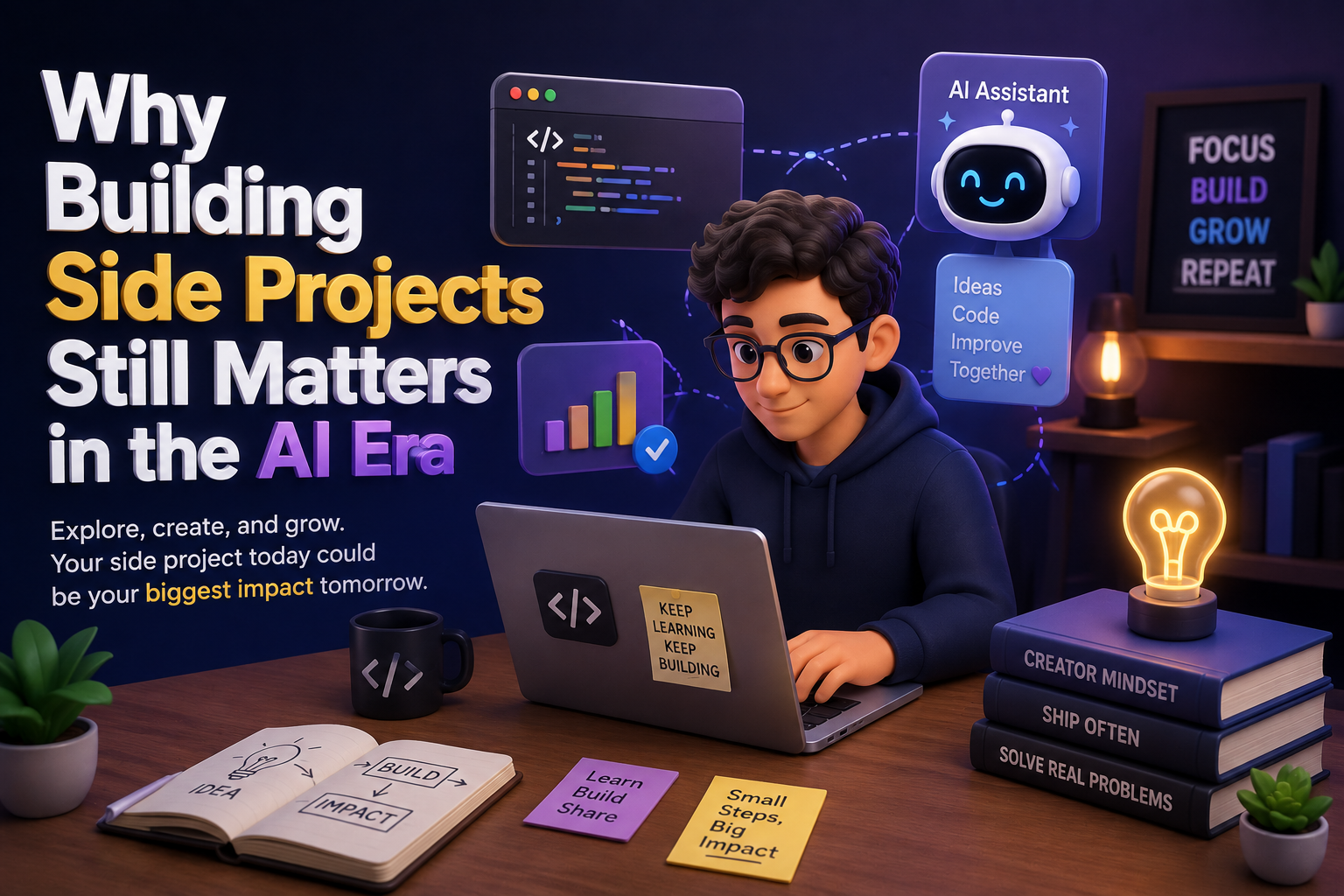
Actually, I think side projects matter even more in the AI era.
But the reason has changed.
A few years ago, building a side project was mostly about improving your coding skills.
Today, it's about something much broader:
Learning how to turn an idea into something real.
And that's a skill AI doesn't automatically give you.
AI Can Write Code. But It Doesn't Choose the Right Problem for You.
Let's say you want to build a productivity application.
You ask an AI tool:
“Build me a task management app using React and Node.js.”
A few seconds later, you might have:
Components
API routes
Database models
Authentication
Styling
Sample data
Pretty impressive.
But here's the more important question:
Should you build a task management app in the first place?
What problem is it solving?
Who is going to use it?
Why would they use it instead of the hundreds of existing tools?
What is the simplest version worth building?
AI can help you implement a solution.
But problem selection is still your responsibility.
That's one of the biggest reasons side projects still matter.
Side Projects Teach You How Software Actually Gets Built
Tutorials are useful.
Courses are useful.
Documentation is useful.
But there's something different about building a project from scratch.
You suddenly have to deal with things like:
“Where should this data live?”
“How should this API work?”
“What happens when the user submits invalid data?”
“Why is this working locally but failing in production?”
“How should authentication work?”
“What happens if the third-party API goes down?”
These aren't isolated coding questions.
They're engineering questions.
And side projects give you a safe environment to experience them.
AI Makes Getting Started Easier. That's a Good Thing.
There's a common fear that AI makes developers lazy.
I think it depends on how you use it.
Imagine you're building an application and you're stuck on an authentication flow.
Before AI tools became widely available, you might spend hours searching:
Documentation
Stack Overflow
GitHub issues
Blog posts
YouTube tutorials
Today, you can ask an AI assistant:
“Explain why this OAuth callback is failing.”
That's incredibly useful.
You can get unstuck faster.
But there's an important difference between:
Using AI to understand a problem
and:
Using AI to avoid understanding the problem.
The first makes you faster.
The second can make you dependent.
Side projects give you an opportunity to use AI without giving up the learning process.
Don't Ask AI to Build Everything
This is probably one of the biggest mistakes developers can make with AI.
You describe your entire application.
AI generates thousands of lines of code.
Everything appears to work.
Then something breaks.
And you have no idea why.
Now you're debugging code you didn't really understand.
That's not much different from downloading a complicated project from GitHub and hoping it works.
A better approach is:
You decide what to build.
AI helps you implement it.
You review the result.
You test it.
You understand the important parts.
Think of AI as a development partner—not an autopilot.
Side Projects Build Product Thinking
This is something tutorials usually don't teach.
When you build a side project, you're not only thinking about code.
You start thinking about the product.
For example:
Who is the user?
What's their problem?
Which feature matters most?
What can I remove?
What should the first version contain?
How do I know whether the product is useful?
This is product thinking.
And product thinking becomes increasingly valuable when coding itself becomes faster.
When implementation gets cheaper, knowing what to build becomes more important.
Side Projects Teach You to Make Trade-Offs
Real software is full of trade-offs.
You might want:
Perfect architecture
100% test coverage
Beautiful UI
Infinite scalability
Zero technical debt
But you probably don't have unlimited time.
So you have to decide:
“What matters most right now?”
Maybe your first version doesn't need microservices.
Maybe PostgreSQL is enough.
Maybe the UI can be simple.
Maybe you don't need Kubernetes.
Maybe you don't need an AI chatbot.
These decisions are difficult.
And side projects let you practice making them.
AI Can Give You Ten Solutions. You Still Need to Choose One.
This is another underrated skill.
Ask an AI:
“How should I implement authentication?”
It might give you five approaches.
Then:
“How should I structure the database?”
Another five.
Then:
“Should I use REST or GraphQL?”
More options.
AI can increase the number of possible solutions.
But that doesn't automatically make decision-making easier.
You need to evaluate:
Complexity
Security
Performance
Maintainability
Cost
Team capability
Business requirements
That's engineering judgment.
And engineering judgment comes from experience.
Side projects are one of the safest ways to build that experience.
Side Projects Give You Something to Show
There's also a practical career benefit.
Imagine two developers applying for the same role.
Developer A says:
“I'm experienced with React, Node.js, PostgreSQL, and Docker.”
Developer B says:
“I built a SaaS application using React, Node.js, PostgreSQL, and Docker. Here's the repository, architecture diagram, API documentation, and live demo.”
The second statement carries more weight.
Not because the person necessarily knows more.
But because there's evidence.
This is where side projects become powerful for a developer portfolio.
They turn:
“I know this technology.”
into:
“I've actually used this technology to build something.”
Side Projects Can Help You Stand Out in the AI Job Market
As AI makes code generation easier, simply listing programming languages may become less differentiating.
Many developers can now generate:
CRUD API
Authentication
Database schema
React component
Unit tests
with assistance.
So what becomes more valuable?
Things like:
Problem solving
System design
Communication
Product thinking
Debugging
Architecture decisions
Understanding trade-offs
Working with real constraints
A well-designed side project can demonstrate several of these at once.
Your Side Project Doesn't Need to Be Original
This is something I wish more developers worried about less.
You don't need to invent the next billion-dollar startup.
Build something that solves a problem you're interested in.
For example:
A personal finance tracker.
A travel planner.
A developer dashboard.
A booking system.
An inventory tool.
A content management system.
An IoT monitoring dashboard.
The goal isn't necessarily to invent something nobody has seen before.
The goal is to experience the process of:
Idea → Requirements → Design → Development → Deployment → Feedback
That's where much of the learning happens.
Build Small Projects Instead of Giant Ones
Another common mistake is trying to build the next Facebook as a side project.
Six months later:
Repository:
my-super-app-v2-final-final
And it's still unfinished.
You don't need that.
Start small.
For example:
Weekend Project
Build a simple URL shortener.
One-Week Project
Build a small expense tracker.
Two-Week Project
Build a lightweight project management tool.
One-Month Project
Build a small SaaS application.
The goal is completion.
A finished small project often teaches you more than an ambitious project that never leaves your laptop.
Deploy Your Side Projects
One of the biggest differences between a tutorial and a real project is deployment.
Try putting your project online.
Now you have to deal with:
Environment variables
Domains
HTTPS
Database configuration
Build processes
Logs
Monitoring
Backups
Production bugs
Suddenly:
“It works on my machine.”
is no longer enough.
This is where side projects become incredibly valuable.
You're experiencing the full software lifecycle.
Let AI Help With the Boring Parts
Not every part of a side project needs to be manually written.
This is where AI can save a huge amount of time.
Let AI help with things like:
Boilerplate
Documentation drafts
Test case generation
SQL suggestions
Refactoring ideas
Error explanations
Code reviews
Regex
Data transformation
Basic UI scaffolding
Then spend your own energy on:
Architecture.
Problem solving.
Product decisions.
Security.
Testing.
Debugging.
User experience.
In other words:
Automate the repetitive work. Keep the important thinking.
Side Projects Teach You How to Debug AI-Generated Code
This skill is becoming increasingly important.
AI-generated code can look convincing.
That's the problem.
Code that looks correct isn't necessarily correct.
Maybe it:
Handles the happy path but not edge cases
Uses insecure defaults
Creates inefficient database queries
Has incorrect assumptions
Breaks under concurrent requests
Doesn't match your existing architecture
When you build side projects, you get opportunities to test those assumptions.
You learn to ask:
“Does this code actually solve my problem?”
Not:
“Does this code look good?”
That's a very different skill.
Side Projects Help You Discover What You Actually Like
This is another underrated benefit.
You might think you want to become:
“A frontend developer.”
Then build a project and realize you enjoy the backend more.
Or you might think:
“I want to work with AI.”
Then discover that what you really enjoy is infrastructure.
Or:
“I like APIs more than UI.”
That's useful information.
A side project is a low-risk way to explore different areas of technology.
You don't need to make a career decision based on theory.
You can try things.
Side Projects Build Your Confidence
There's a psychological benefit too.
The first time you deploy an application you built yourself, there's a certain feeling:
“Wait... I actually built this.”
Then you build another.
Then another.
Eventually, problems that once looked intimidating become familiar.
You start thinking:
“I've seen something like this before.”
That's confidence based on experience.
Not confidence from watching another tutorial.
The Goal Is No Longer “Write More Code”
This is probably the biggest shift in the AI era.
Before AI:
More coding practice → Better coding skills.
Today:
More building experience → Better engineering judgment.
The goal isn't to type more code than AI.
You're probably not going to win that competition.
The goal is to become better at:
Understanding problems.
Making decisions.
Reviewing solutions.
Designing systems.
Testing assumptions.
Working with users.
Shipping products.
AI can help accelerate many of these activities.
But you still need the experience to know what good looks like.
A Simple Side Project Strategy in the AI Era
Here's a workflow I've found useful:
1. Start With a Problem
Don't start with:
“I want to use React.”
Start with:
“I want to solve this problem.”
2. Define a Small MVP
Write down the minimum features.
3. Design the Solution
Think about the architecture before asking AI to generate code.
4. Use AI as a Pair Programmer
Ask it to help with implementation, explanations, alternatives, and debugging.
5. Review Everything Important
Especially:
Authentication
Authorization
Database queries
Security
Error handling
External integrations
6. Deploy It
Get the project into a real environment.
7. Write About What You Learned
Document:
What you built
Why you chose the architecture
What went wrong
What you would change
What you learned
Now you have both a project and a story.
Your Side Project Can Become More Than a GitHub Repository
This is where things get interesting.
A single side project can become:
GitHub repository → Code evidence
Portfolio project → Visual showcase
Blog article → Demonstrate technical thinking
LinkedIn post → Share the journey
Demo → Show the product
Case study → Explain the business problem
One project can create multiple pieces of useful content.
That's especially powerful when you're building a personal brand.
Final Thoughts
The AI era is changing how software gets built.
There's no doubt about that.
Writing code is becoming faster.
Prototyping is becoming easier.
Learning technical concepts is becoming more accessible.
But that doesn't make building things irrelevant.
It makes real building experience more valuable.
Because when AI can generate ten possible solutions, someone still needs to decide which solution makes sense.
When AI can generate an entire application, someone still needs to understand the problem.
When AI can write the code, someone still needs to test whether the product actually works.
That's why I still believe in side projects.
Not because you need to prove that you can code without AI.
But because you need to prove that you can build with intention.
So don't compete with AI on how many lines of code you can write.
Use it to build something you've been thinking about.
Ship it.
Break it.
Fix it.
Learn from it.
Then build the next thing.
Because in the AI era, the developers who stand out won't necessarily be the ones who write the most code.
They'll be the ones who know what to build, why to build it, and how to turn an idea into something real.
Looking for a Developer to Turn an Idea Into a Real Product?
Side projects are a great way to learn, but real products come with real constraints—requirements, integrations, security, deployment, performance, and users.
I work across web development, backend systems, API integration, software architecture, and digital product development, and I'm open to freelance projects, technical consulting, and collaboration.
Whether you have an MVP idea, an existing application that needs improvement, or a technical problem you're trying to solve, let's discuss it.
Have an idea you've been sitting on? Let's turn it into something real.
Are you still building side projects in the AI era? What are you currently working on?