Have you ever been working on a software project and suddenly someone says:
“Can we just add one more feature?”
Sounds harmless, right?
The feature might seem small. Maybe it only needs a few buttons, a simple API endpoint, or one additional field in the database.
So the team says, “Sure, it shouldn’t take long.”
Then another request comes.
And another.
Before you know it, the original project has changed completely.
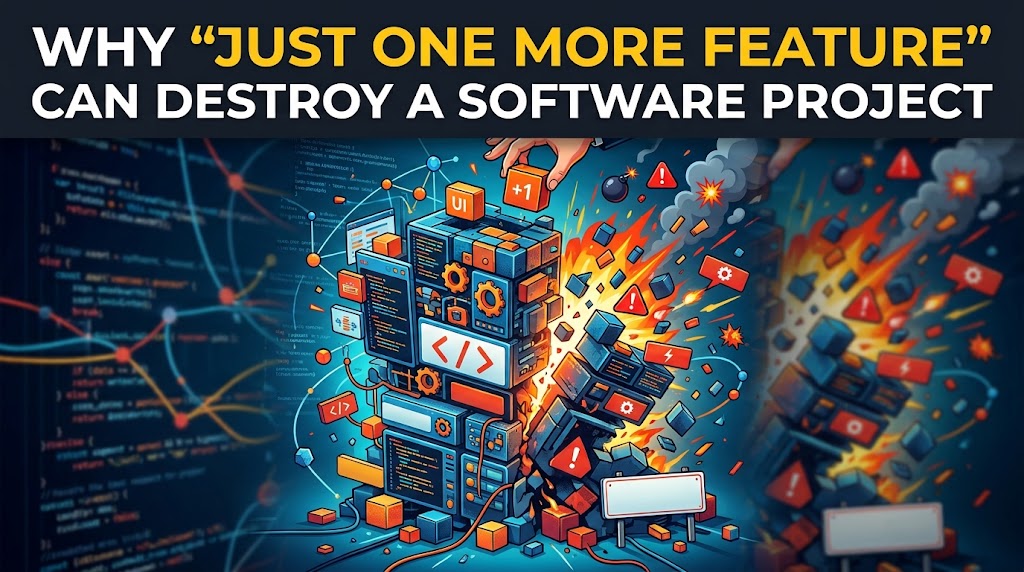
This is one of the most common problems in software development: scope creep.
The dangerous part is that scope creep rarely starts with a huge request. It usually starts with something that sounds very reasonable: “just one more feature.”
What Is Scope Creep?
Scope creep happens when new requirements, features, or changes are added to a project after the original scope has already been agreed upon.
The problem isn't always the feature itself.
The real problem is the accumulation of small changes.
Imagine your team plans to build an e-commerce website with:
Product catalog
Shopping cart
Checkout
Payment integration
Order tracking
Then someone says:
“Can we also add a wishlist?”
Sure.
Then:
“Can users compare products?”
Okay.
Then:
“Can we add product recommendations using AI?”
Now the project has become much larger than originally planned.
Each feature may look manageable on its own. But together, they can significantly change the project's timeline, budget, architecture, and complexity.
Why Does “One More Feature” Become So Dangerous?
1. Small Features Still Need Development Time
One of the biggest misconceptions in software development is that a small feature always takes a small amount of time.
It doesn't.
A feature may require:
Database changes
Backend logic
API updates
Frontend development
Authentication changes
Testing
Documentation
Deployment
Monitoring
For example, adding a simple “favorite” button sounds easy.
But what happens behind the scenes?
You may need a new database table, API endpoints, authorization rules, UI states, error handling, and test cases.
Suddenly, your “small feature” isn't so small anymore.
2. Features Create Dependencies
Software systems are interconnected.
Changing one part of the system can affect several other parts.
Let's say you add a new payment method.
It might affect:
Frontend → Backend → Payment Gateway → Order Service → Database → Notification System
One change can create a chain reaction.
This is why developers often say:
“It's not the feature itself. It's everything around the feature.”
3. The Project Timeline Keeps Moving
This is where things become frustrating.
The team originally planned to finish the project in three months.
Then new features keep appearing.
Three months becomes four.
Four becomes five.
Eventually, stakeholders start asking:
“Why is this project taking so long?”
The uncomfortable answer is often simple:
Because the project is no longer the same project.
The target keeps moving while the deadline stays the same.
4. More Features Mean More Bugs
Every additional feature introduces new code.
More code means more possible interactions between components.
And more interactions mean more opportunities for bugs.
For example, adding a new discount feature might accidentally affect:
Checkout calculations
Tax calculations
Invoice generation
Payment processing
Reporting
A new feature doesn't only need to work by itself.
It must also work without breaking existing functionality.
That's where testing becomes increasingly important.
5. Developers Lose Focus
Constant changes are mentally expensive for development teams.
A developer may spend two days working on Feature A.
Then suddenly:
“Let's pause that. We need Feature B first.”
The developer switches context.
Later:
“Actually, let's prioritize Feature C.”
This creates context switching, which can reduce productivity and make development more chaotic.
The team isn't necessarily working faster because they're doing more things.
They're often just starting more things and finishing fewer of them.
The Hidden Cost of Feature Creep
The cost of scope creep isn't just development hours.
There are at least four major hidden costs.
Technical Debt
Developers may rush implementation because the team needs to accommodate another requirement quickly.
That can lead to shortcuts.
Those shortcuts eventually become technical debt.
Maintenance
Every feature that gets added must eventually be maintained.
That means future developers need to understand it, test it, fix it, and potentially migrate it.
User Experience
More features don't automatically create a better product.
Sometimes they make the product harder to use.
A product with 50 features isn't necessarily better than one with 10 well-designed features.
Team Burnout
Constant pressure to add features while maintaining the same deadline can exhaust developers, QA engineers, project managers, and designers.
Eventually, the team starts paying the price.
“But the Customer Asked for It”
This is where things get complicated.
Customer requests aren't bad.
Actually, customer feedback is extremely valuable.
The problem is implementing every request immediately.
A better approach is to evaluate the request based on:
Business value + user impact + effort + urgency
for example:
Feature | Business Value | Effort | Priority |
|---|---|---|---|
Payment integration | High | High | Critical |
Wishlist | Medium | Medium | Later |
Dark mode | Low | Low | Backlog |
AI recommendation | High | Very High | Evaluate |
This helps the team separate important features from interesting features.
How to Prevent “Just One More Feature”
Define the MVP Clearly
An MVP, or Minimum Viable Product, should contain only the functionality necessary to solve the core problem.
Ask:
“What is the minimum product we need to launch and learn from users?”
Not:
“What features can we fit into the first release?”
Those are very different questions.
Create a Backlog
Not every idea needs to be rejected.
Some ideas simply need to wait.
Put them into a backlog.
This gives stakeholders confidence that the idea hasn't been forgotten while protecting the current sprint or release.
Use Change Requests
When someone proposes a new feature, ask:
What is the impact?
For example:
“Adding this feature will require another 7 development days and 2 days of testing. This may move the release date from September 10 to September 20.”
Now the discussion becomes a business decision instead of an emotional argument.
Protect the Sprint
In Agile development, a sprint should have a clear goal.
Constantly adding new work halfway through the sprint can make that goal meaningless.
New ideas can be documented and prioritized for future work instead.
Ask the Most Important Question
When someone says:
“Can we add this one small feature?”
Ask:
“What problem are we solving with this feature?”
This question is surprisingly powerful.
Sometimes the answer reveals that the feature isn't actually necessary.
Other times, the answer shows that the feature is extremely important.
Either way, you're making a decision based on value rather than excitement.
The Real Goal Isn't “More Features”
A successful software project isn't measured by how many features the team manages to ship.
It's measured by whether the product solves the right problem.
A simple product that users actually need can be far more successful than a complex product filled with unused functionality.
That's why great software teams don't simply ask:
“Can we build it?”
They also ask:
“Should we build it now?”
Those two questions can completely change the outcome of a project.
Final Thoughts
“Just one more feature” doesn't sound dangerous.
But in software development, small requests can accumulate into large problems.
One feature can increase development time.
Five features can change the architecture.
Ten features can turn a focused MVP into an overloaded product.
The lesson isn't to reject every new idea.
The lesson is to control when and why new ideas enter the project.
Because sometimes the best feature you can add to a software project...
is the feature you decide not to build yet.